
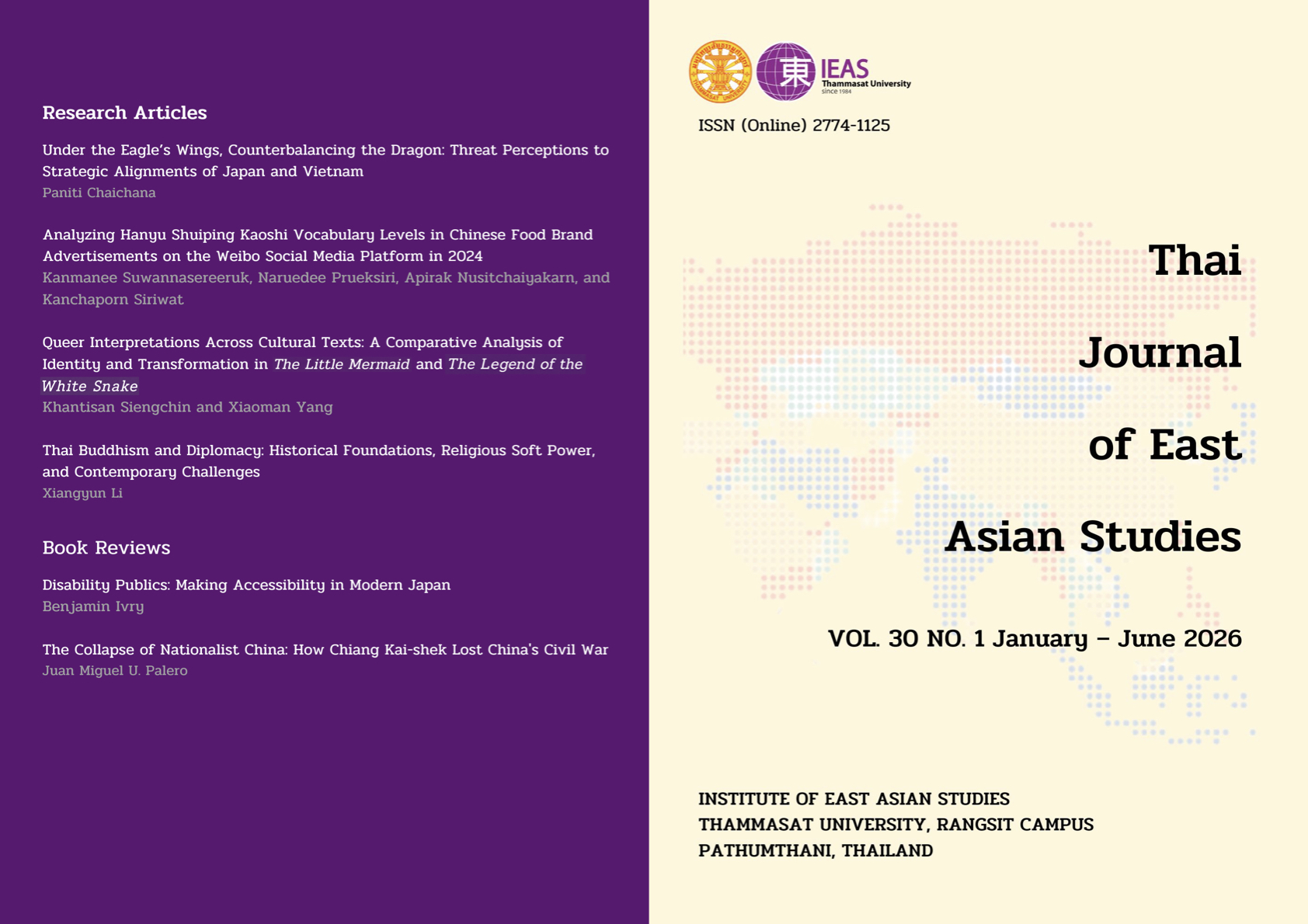
Queer Interpretations Across Cultural Texts: A Comparative Analysis of Identity and Transformation in The Little Mermaid and The Legend of the White Snake
Keywords:
Queer Theory, The Little Mermaid, The Legend of the White Snake, comparative literature, Queer identityAbstract
This qualitative research comparatively analyzes queer identity and trans-species transformation in the literary works The Little Mermaid by Hans Christian Andersen and the Chinese folktale The Legend of the White Snake. Using literary analysis and comparative literary methodology, the study is framed by Queer Theory, specifically focusing on Judith Butler’s concept of performativity and the concept of humanormativity. Results are that both narratives reflect painful identity transitions and forbidden love; despite being systemically suppressed, the characters show resilience in pursuing agency and self-existence. Future research might expand to other media forms and analyze reception by the lesbian, gay, bisexual, transgender, queer/questioning, and other (LGBTQ+) community.
Downloads
References
Andersen, H. C. (1945). Andersen's fairy tales (E. V. Lucas & H. B. Paull, Trans.). Grosset & Dunlap. (Original work published 1872)
Balivet, A. (2020). The many transformations of White Snake: Gender, ritual, and performance in late imperial China (Publication No. 27736793) [Doctoral dissertation, University of Wisconsin–Madison]. ProQuest Dissertations & Theses Global. https://www.proquest.com/openview/a9997bc17fe10f5937482fb5c188ace0
Bellot, G. (2019, July 12). Dear internet: The Little Mermaid also happens to be queer allegory. Literary Hub. https://lithub.com/dear-internet-the-little-mermaid-also-happens-to-be-queer-allegory/
Butler, J. (1990). Gender trouble: Feminism and the subversion of identity. Routledge.
Butler, J. (1993). Bodies that matter: On the discursive limits of “sex”. Routledge.
Chen, Y. (2022). Between femininity and animality: The metamorphosis of the White Snake legend in Sinophone film and TV. In Proceedings of the 2022 8th international conference on humanities and social science research (ICHSSR 2022) (pp. 2859–2867). Atlantis Press. https://doi.org/10.2991/assehr.k.220504.519
Danzig, P. A. (2024, July 1). Expressing queer identity through “The Little Mermaid.” Psychology Today. https://www.psychologytoday.com/us/blog/dont-toy-with-me/202406/expressing-queer-identity-through-the-little-mermaid
Derrida, J. (1976). Of Grammatology (G. C. Spivak, Trans.). Johns Hopkins University Press.
馮夢龍 [Feng Menglong]. (1624). 警世通言·第二十八卷 白娘子永鎮雷峰塔 [Stories to Caution the World, Vol. 28: Madam White Is Kept Forever Under the Leifeng Pagoda]. Wikisource. Retrieved December 4, 2025, from https://zh.wikisource.org/wiki/警世通言/第28卷
Halperin, D. M. (1995). Saint Foucault: Towards a gay hagiography. Oxford University Press.
Jagose, A. (1996). Queer theory: An introduction. New York University Press.
Starnes, L. G. (2013). Performing transgender identity in The Little Mermaid: From Andersen to Disney. Communication Studies, 65(1), 112-127. https://doi.org/10.1080/10510974.2013.832691
Warner, M. (Ed.). (1993). Fear of a queer planet: Queer politics and social theory. University of Minnesota Press.
Wolfe, C. (2003). Zoontologies: The question of the animal. University of Minnesota Press.
Downloads
Published
How to Cite
Issue
Section
License
Copyright (c) 2026 Thai Journal of East Asian Studies

This work is licensed under a Creative Commons Attribution-NonCommercial-NoDerivatives 4.0 International License.


