
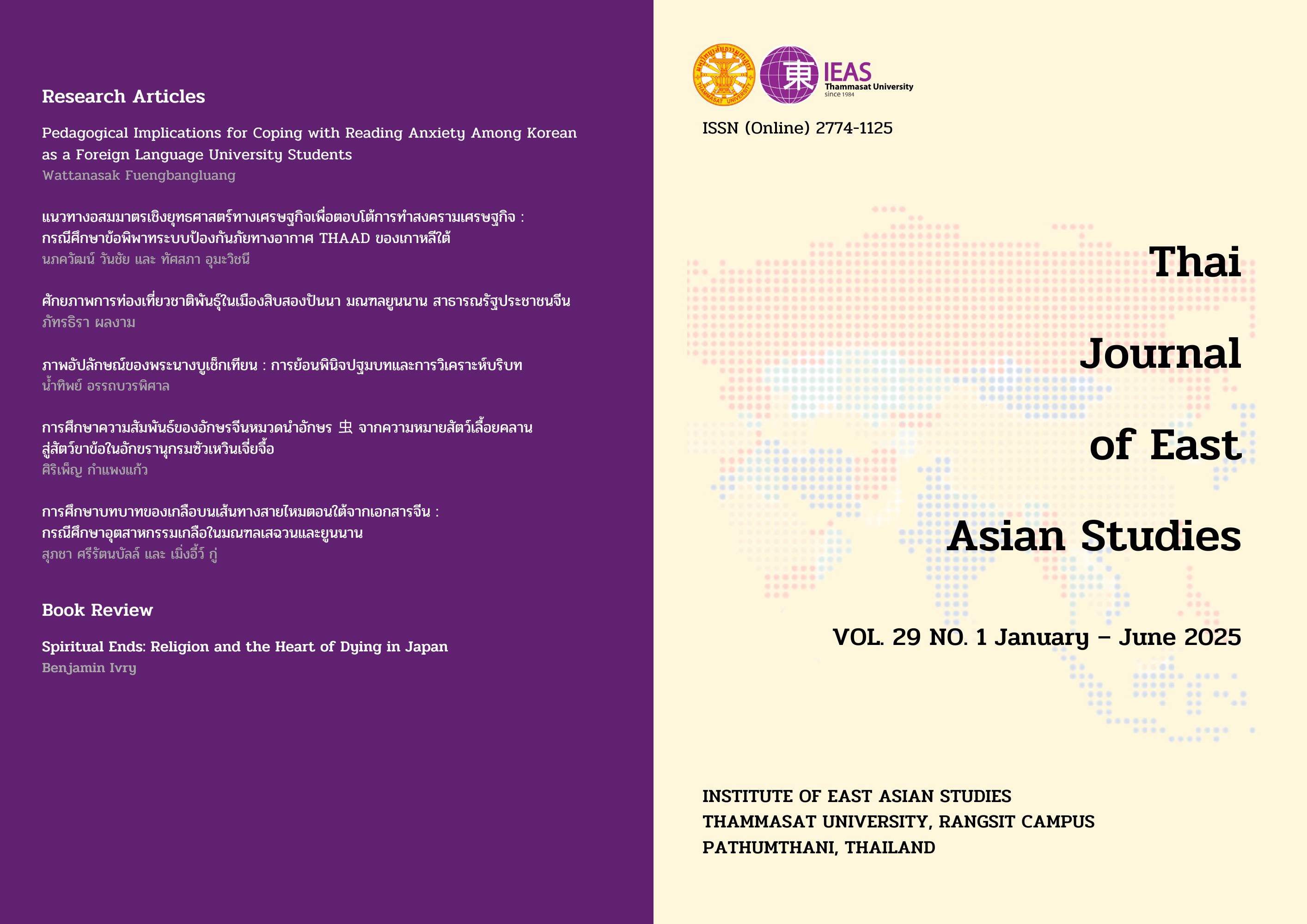
A Study of the Role of Salt on the Southern Silk Road from Chinese Historical Documents: A Case Study of the Salt Industry in Sichuan and Yunnan Provinces
Keywords:
Southern Silk Road, ancient Chinese documents, salt trade, Sichuan province, Yunnan provinceAbstract
This article examines the role of salt on the Southern Silk Road by analyzing the development of the salt industry in Sichuan and Yunnan provinces, using ancient Chinese documents as primary sources. Results are that sodium chloride has two key significant aspects:
First, salt functioned as a strategic resource in the economic structure of the imperial Chinese state. Sichuan and Yunnan were major centers of salt production starting from the Qin and Han dynasties. Continuous technological advances expanded the salt industry, making the two provinces into key distribution centers. The imperial state strictly monopolized and taxed salt, establishing specialized administrative agencies to oversee its production, trade, and taxation. The market was regulated by issuing salt trade licenses. The state monopoly on salt generated vital royal court revenue and controlled local economies, supported military logistics, and reinforced political stability. Therefore, salt was a strategic resource linked to the public livelihood, economic structure, and state security.
Secondly, salt was an essential commodity and currency in local economies, particularly in frontier areas. In Yunnan province borderlands, part of the Southern Silk Road network connecting to Myanmar, Thailand, and Laos, salt was a basic daily product and in certain areas, used as a trade value unit. This was especially so in ethnic group exchanges and at community markets, reflecting the flexibility of regional economies where formal currency systems were inchoate.
Downloads
References
เอกสารชั้นต้น
(Eastern Han) Ban Gu 班固撰, (Qing) Wang Xianqian 王先谦补注. (2008). 汉书补注. 上海:上海古籍出版社.
(Eastern Jin) Chang Qu 常璩原著;Wang Qiming汪启明,Zhao Jing 赵静译注. (2007). 华阳国志译注. 成都:四川大学出版社.
(Tang) Fan Chuo 樊绰撰, Xiang Da向达校注. (2023). 蛮书校注. 二版.北京:中华书局.
(Yuan) Tuotuo 脱脱等撰. (1977). 宋史. 北京:中华书局.
(Ming) Ming Shilu 明实录. (1962). 台北:中央研究院历史语言研究所.
(Ming) Song Lian 宋濂等撰. (1976). 元史. 北京:中华书局.
(Ming) Li Yuanyang李元阳纂. (2007).〔万历〕云南通志. Guo Huiqing 郭惠青,Li Gong 李公主编.大理丛书·方志篇·卷一. 北京:民族出版社.
(Qing) Qing Shilu 清实录. (1986). 北京:中华书局.
เอกสารชั้นรอง
คณะกรรมการสืบค้นประวัติศาสตร์ไทยในเอกสารภาษาจีน. (2543). เกณฑ์การถ่ายทอดเสียงภาษาจีนแมนดารินด้วยอักขรวิธีไทย. โรงพิมพ์มหาวิทยาลัยธรรมศาสตร์.
มานูเอล, คอมรอฟฟ์. (2556). การเดินทางของมาร์โค โปโล (รวีโรจน์ เตยต่อวงศ์กุล, ผู้แปล). ยิปซี.
วิชญา มาแก้ว. (2559). ระบบเศรษฐกิจและความเปลี่ยนแปลงทางสังคมในยุคทองของอาณาจักรล้านนา (ค.ศ.1355-1525) [วิทยานิพนธ์ปริญญามหาบัณฑิต ไม่ได้ตีพิมพ์]. มหาวิทยาลัยเชียงใหม่.
Jia Daquan 贾大泉. (1982). 宋代四川井盐产量剖析. 西南大学学报, (4), 62-69.
Li Jingheng李竞恒. (2021). 古代南方丝绸之路沿线的西南夷远程贸易. 中华文化论坛, (3), 26-33; 155-156.
Lin Wenxun 林文勋. (2013). “贝币之路” 及其在云南边疆史研究中的意义. 中国边疆史研究, 23(1), 1-9; 147.
Lu Yixu 路义旭. (2003). 论西南丝绸之路的研究状况. 西南民族大学学报(人文社会科学版), (11), 221-224.
Qiu Long 邱隆. (2006). 中国历代度量衡单位量值表及说明. 中国计量, (10), 46-48; 76.
Qu Xiaoling 屈小玲. (2011). 中国西南与境外古道:南方丝绸之路及其研究述略. 西北民族研究, (1), 172-179.
Sun Zhongwen 孙仲文. (1993). “南方丝绸之路”货币初探. 南洋问题研究, (1), 46-52; 61.
Tan Jia 谭佳. (2024). 明代南方丝绸之路沿线盐业概况——以杨慎诗文为中心的考述. 云南档案, (1), 25-29.
Zhao Xiaoping 赵小平. (2002). 试论滇盐在商品流通中的历史作用. 盐业史研究, (1), 3-7.
Zou Yiqing 邹一清. (2016). 南方丝绸之路对外贸易的研究及展望. 中国史研究动态, (4), 22-28.
Zou Yiqing 邹一清. (2017). 南方丝绸之路与道教在东南亚的传播. 中华文化论坛, (10), 116-124; 192.
Zou Yiqing 邹一清. (2018). 南方丝绸之路丛书:贸易通天下. 重庆:重庆大学出版社.
Downloads
Published
How to Cite
Issue
Section
License
Copyright (c) 2025 Thai Journal of East Asian Studies

This work is licensed under a Creative Commons Attribution-NonCommercial-NoDerivatives 4.0 International License.


