
การประเมินปัจจัยองค์ประกอบด้านการท่องเที่ยวชุมชนชาติพันธุ์บ้านธงชัย ตำบล ด่านแม่ละเมา อำเภอแม่สอด จังหวัดตาก
Article Sidebar
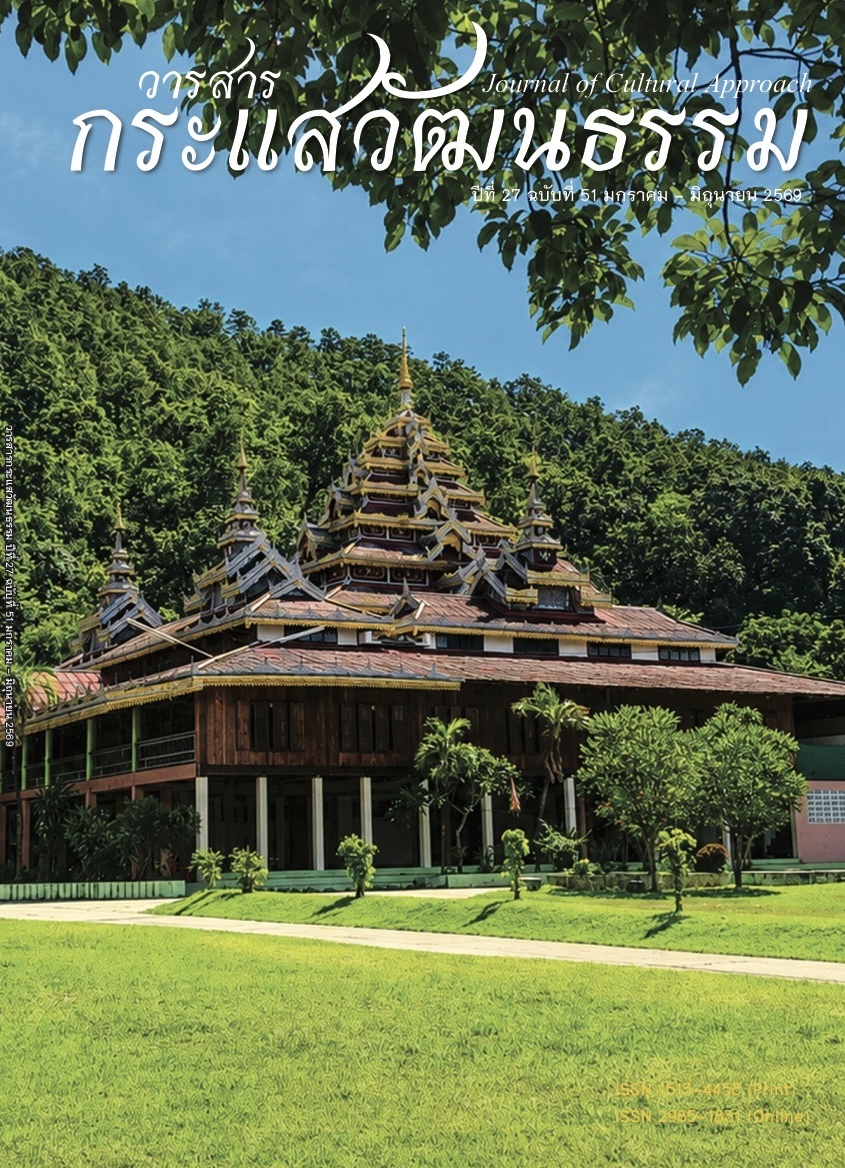
Main Article Content
บทคัดย่อ
บทความนี้ มีวัตถุประสงค์เพื่อประเมินปัจจัยองค์ประกอบด้านการท่องเที่ยวชุมชนชาติพันธุ์ของบ้านธงชัย ตำบลด่านแม่ละเมา อำเภอแม่สอด จังหวัดตาก การศึกษาในครั้งนี้มีการทบทวนวรรณกรรมอย่างมีระบบ ใช้เทคนิคการวิเคราะห์และสังเคราะห์ แนวคิด ทฤษฎีที่เกี่ยวข้อง โดยนำมาสร้างแบบประเมินปัจจัยองค์ประกอบด้านการท่องเที่ยวชุมชนชาติพันธุ์ จากนั้นนำไปเก็บข้อมูลจากภาคีเครือข่ายด้านการท่องเที่ยว จำนวน 9 คน และนำผลการประเมินมาวิเคราะห์ศักยภาพด้านการท่องเที่ยวชุมชนชาติพันธุ์ในพื้นที่ ผลการประเมินพบว่า องค์ประกอบด้านที่พัก (x̅ = 4.41) อยู่ในระดับมากที่สุด รองลงมาด้านความสะดวกในการเข้าถึงและการให้บริการ (x̅ = 4.38) อยู่ในระดับมากที่สุด ถัดมาด้านกิจกรรมและเส้นทางท่องเที่ยว (x̅ = 4.37) อยู่ในระดับมากที่สุด ลำดับถัดมา ด้านสิ่งดึงดูดใจ (x̅ = 4.35) อยู่ในระดับมากที่สุด รองลงมา ด้านการรับรู้ (x̅ = 4.14) อยู่ในระดับมาก และด้านสิ่งอำนวยความสะดวกและโครงสร้างพื้นฐาน (x̅= 3.38) อยู่ในระดับปานกลาง ตามลำดับ
Article Details

อนุญาตภายใต้เงื่อนไข Creative Commons Attribution-NonCommercial-NoDerivatives 4.0 International License.
Proposed Creative Commons Copyright Notices
1. Proposed Policy for Journals That Offer Open Access
Authors who publish with this journal agree to the following terms:
- Authors retain copyright and grant the journal right of first publication with the work simultaneously licensed under a Creative Commons Attribution License that allows others to share the work with an acknowledgement of the work's authorship and initial publication in this journal.
- Authors are able to enter into separate, additional contractual arrangements for the non-exclusive distribution of the journal's published version of the work (e.g., post it to an institutional repository or publish it in a book), with an acknowledgement of its initial publication in this journal.
- Authors are permitted and encouraged to post their work online (e.g., in institutional repositories or on their website) prior to and during the submission process, as it can lead to productive exchanges, as well as earlier and greater citation of published work (See The Effect of Open Access).
Proposed Policy for Journals That Offer Delayed Open Access
Authors who publish with this journal agree to the following terms:
- Authors retain copyright and grant the journal right of first publication, with the work [SPECIFY PERIOD OF TIME] after publication simultaneously licensed under a Creative Commons Attribution License that allows others to share the work with an acknowledgement of the work's authorship and initial publication in this journal.
- Authors are able to enter into separate, additional contractual arrangements for the non-exclusive distribution of the journal's published version of the work (e.g., post it to an institutional repository or publish it in a book), with an acknowledgement of its initial publication in this journal.
- Authors are permitted and encouraged to post their work online (e.g., in institutional repositories or on their website) prior to and during the submission process, as it can lead to productive exchanges, as well as earlier and greater citation of published work (See The Effect of Open Access).
เอกสารอ้างอิง
Adhikari, B. B. (2020). Steps Taken for Development of Home Stay Tourism in Nepal. NUTA Journal, 7(1–2), 18–30.
Ampornphan, J. (2004). Tourism Resources. Sripatum University.
Bunthip, T. (2020). Community-based Ecotourism Management Tha Khanon Subdistrict, Khiri Rat Nikhom District, Surat Thani Province. Journal of Human Society, 10(2), 81–93.
Busayamarn, P., Jangjing, S., Saekong, J., Makeng, I., Kamuning, M., Itsarathanachaikul, S. & Uden, M. (2019). The Participation of Local Administrative in Tourism Management of OTOP Nawatvithi: A Study of Natham Sub-district, Meang Yala District, Yala Province. Yala Rajabhat University.
Choibamroong, T. (2009). The Role of Local Administrative Organizations in Sustainable Tourism Development Based on the Concept of Sufficiency Economy. Cabinet and Royal Gazette Publishing.
Chomphoopanya, A. & Rojanatrakul, T. (2022). The Development Potential of the Community of Participant Model to Sustainable Tourism Community. Journal of Modern Learning Development, 7(8), 414–430.
Coskun, H. (2021). A Lesson Design of the Subject of Local Cuisine as a Course Unit in Language Teaching. The Journal of Education, Culture, and Society, 11(1), 479–503.
Cracolici, M. F. & Nijkamp, P. (2009). The Attractiveness and Competitiveness of Tourist Destinations: A Study of Southern Italian Regions. Tourism Management, 30(3), 336–344.
Duarte-Alonso, A. & Kiat-Kok, S. (2021). Sense of Place and Certainty in Uncertain Socioeconomic Conditions: Contributions of Local Cuisine to Culinary Tourism. Journal of Heritage Tourism, 16(3), 247–262.
Economic, Tourism and Sports Division (ETS). (2024). Tourism Trend 2024. Ministry of Tourism and Sports.
Emphandhu, D. (2007). Community Based Tourism Development and Homestay Activities. Kasetsart University.
Heuman, D. (2005). Hospitality and Reciprocity: Working Tourists in Dominica. Annals of Tourism Research, 32(2), 407–418.
Karatepe, O. M. & Olugbade, O. A. (2016). The Mediating Role of Work Engagement in the Relationship between High–Performance Work Practices and Job Outcomes of Employees in Nigeria. International Journal of Contemporary Hospitality Management, 28(10), 2350–2371.
Kerdchan, O. (2014). Participation of Local Communities in Ecotourism Management, Mangrove Forest, Khlong Khon, Samut Songkhram Province. Dhurakij Pundit University.
Khairi, M. & Darmawan, D. (2021). The Relationship between Destination Attractiveness, Location, Tourism Facilities, and Revisit Intentions. Journal of Marketing and Business Research (MARK), 1(1), 39–50.
Khopolklang, N. & Kaewsanga, K. (2021). Capabilities Development of Local Community for Creative Tourism, Chiang Khan, Loei Province. Journal of Thai Hospitality and Tourism, 16(1), 12–25.
Kumboon, A. & Kovathanakul, D. (2013). The Small Town Assessment, Khemmaraj District, Ubon Ratchathani Province. Journal of Thai Hospitality and Tourism, 8(2), 3–22.
Nadalipour, Z., Hassan-Rathore, A. & Fazeli-Tabar, S. (2022). Promoting Traditional Cuisine as a Cultural Tourism Product: A Local Community’s Involvement Approach. International Journal of Tourism, Culture & Spirituality, 5(2), 167–185.
National Tourism Council (NTC). (2023). National Tourism Development Plan No.3 (2023–2027). Ministry of Tourism and Sports.
Nuancha, P. & Ladavalya Na Aytuthya, S. (2020). Tourism Network Governance of Ban Mew Kampong Village, Huay Kare Sub-district, Mae-On District, Chiang Mai Province. Journal of Political Science and Public Administration, 11(2), 29–54.
Oktaviani, D. (2023). Cultural Tourism Development Policy through Community Based Tourism (CBT) in the Framework of Community Poverty Alleviation. Journal of Social Interactions and Humanities, 2(2), 127–138.
Pianluprasidh, P., Pradera Diaz, J. & Yodsuwan, C. (2024). The Guideline for Health Tourism Activities Development for Senior Tourists at Resorts in Chiang Rai. The Golden Teak: Humanity and Social Science Journal, 30(2), 46–61.
Plaituka, C. W., Jehana, P. T. & Flora, V. A. (2022). Identification of the Tourism Potential Based on Attractions, Amenities and Accessibility in South of Amfoang District, East Nusa Tenggara. Presented in the International Conference on Applied Science and Technology on Social Science 2021, Atlantis Press.
Reitsamer, B. F. & Brunner-Sperdin, A. (2017). Tourist Destination Perception and Well-being: What Makes a Destination Attractive? Journal of Vacation Marketing, 23(1), 55–72.
Robustin, T. P., Andi, R., Suroso, I. & Yulisetiarini, D. (2018). The Contribution of Tourist Attraction, Accessibility and Amenities in Creating Tourist Loyalty in Indonesia. Journal of Business and Economics Review, 3(4), 92–98.
Sharma, J., Nagar, L. & Chaurasia, N. (2021). If Cuisine is Local, How Cuisine Be Termed as National? Presented in the 5th International Conference I-Host 2021: Hospitality & Tourism “New Normal” in Hospitality & Tourism: Skill, Innovation and Technology, New Delhi.
Suansri, P. & Yijorho, S. (2013). Community Based Tourism Standards Manual. Payap University.
Thongma, W. (2016). Community Based Tourism (CBT) for Improving the Quality of Life of Communities in Forest Land Areas. http://www.dnp.go.th/ fca16/file/i49xy4ghqzsh3j1.doc
