
DANCE PRACTICE SKILLS INSTRUCTION FOR RABAM MATRATHAN : LESSON LEARNED FROM THE NATIONAL ARTISTS Dance Practice Skills Instruction for Rabam Matrathan: Lesson Learned from The National Artists
Article Sidebar
Main Article Content
Abstract
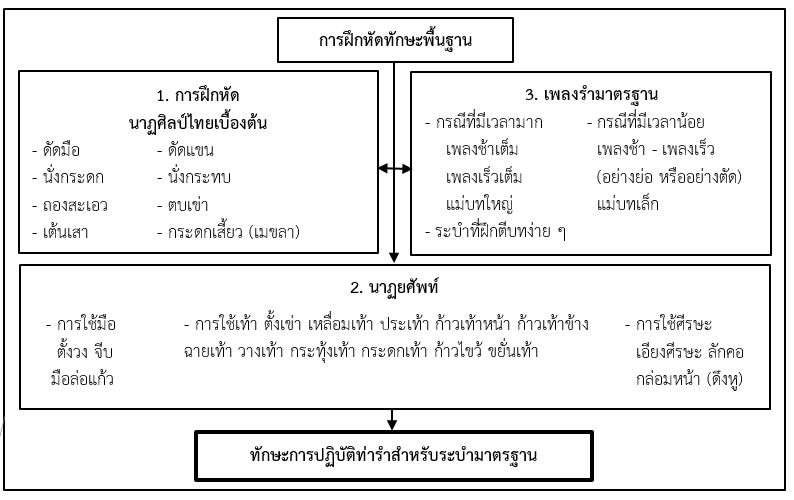
This study examined pedagogical practices in teaching Rabam Matrathan through lesson extraction from Thai National Artists in the field of performing arts. The study aimed to investigate how dance practice skills are transmitted within Thai classical dance education and to conceptualize the instructional processes embedded in traditional dance pedagogy. A qualitative research approach was employed. Data were collected from four National Artists through in-depth interviews and participant observation and analyzed using thematic analysis. The findings revealed that instruction in Rabam Matrathan is not merely the transmission of dance movements according to traditional conventions, but a systematic process of embodied and experiential learning. Four major pedagogical components were identified: 1) essential fundamental knowledge, 2) encouragement and motivation, 3) systematic instructional procedures, and 4) various teaching techniques. The instructional process emphasized demonstration, physical guidance, repetitive practice, rhythmic control, and metaphorical explanation as central mechanisms for skill development and knowledge transmission. The findings further suggest that Thai classical dance instruction reflects principles of embodied pedagogy, tacit knowledge transmission, and performing arts education, in which learning occurs through bodily practice, close teacher–student interaction, and experiential engagement. This study contributes to the field of Thai Classical Dance Pedagogy by conceptualizing traditional Thai dance instruction as a systematic pedagogical process rather than merely a form of cultural preservation.
Article Details

This work is licensed under a Creative Commons Attribution-NonCommercial-NoDerivatives 4.0 International License.
All authors must take public responsibility for the content of their paper. The WIPIT Journal Editors will not be taking any public responsibility for the content in the paper.
References
กรมส่งเสริมวัฒนธรรม. (2562). ศิลปินแห่งชาติ พุทธศักราช 2562. โรงพิมพ์องค์การสงเคราะห์ทหารผ่านศึก.
ชมนาด โศภน. (2531). พัฒนาการของการศึกษาวิชาชีพนาฏศิลป์ไทยในประเทศไทย [วิทยานิพนธ์ปริญญามหาบัณฑิต, จุฬาลงกรณ์มหาวิทยาลัย]. คลังปัญญาจุฬาฯ. https://doi.org/10.58837/CHULA.THE.1988.357
ชวลิต สุนทรานนท์. (2549). ทะเบียนข้อมูล : วิพิธทัศนา ชุดระบำ รำ ฟ้อน. บริษัท ไทภูมิ พับลิชชิ่ง จำกัด.
ชวลิต สุนทรานนท์. (2550). ทะเบียนข้อมูล : วิพิธทัศนา ชุดระบำ รำ ฟ้อน เล่ม 2. บริษัท ไทภูมิ พับลิชชิ่ง จำกัด.
ปราณี สำราญวงศ์. (2525). ศิลปวัฒนธรรม เล่มที่ 7: นาฏดุริยางคศิลป์ไทยยุครัตนโกสินทร์. กรมศิลปากร.
วิจารณ์ พานิช. (2548). การจัดการความรู้ ฉบับนักปฏิบัติ. สถาบันส่งเสริมการจัดการความรู้เพื่อสังคม.
ศุภวัลย์ พลายน้อย. (2549). บทเรียนของการถอดบทเรียนในการจัดการเรียนรู้ภาคประชาคม. พี.เอ.ลีฟวิ่ง จำกัด.
อุษา สบฤกษ์. (2536). การศึกษาพฤติกรรมการสอนนาฏศิลป์ไทยในวิทยาลัยนาฏศิลป์ไทย [วิทยานิพนธ์ปริญญามหาบัณฑิต, จุฬาลงกรณ์มหาวิทยาลัย]. คลังปัญญาจุฬาฯhttps://doi.org/10.58837/CHULA.THE.1993.323
Eraut, M. (2000). Non-formal learning and tacit knowledge in professional work. British Journal of Educational Psychology, 70(1), 113–136. https://doi.org/10.1348/000709900158001
Gilbert, A. G. (2015). Creative dance for all ages (2nd ed.). Human Kinetics.
Green, J. (2002). Somatic knowledge: The body as content and methodology in dance education. Journal of Dance Education, 2(4), 114-118.
Kassing, G., & Jay, D. M. (2003). Dance teaching methods and curriculum design. Human Kinetics.
Lave, J., & Wenger, E. (1991). Situated learning: Legitimate peripheral participation. Cambridge University Press.
Leavy, P. (2018). Handbook of arts-based research. Guilford Press.
Mainwaring, L. M., & Krasnow, D. H. (2010). Teaching the dance class: Strategies to enhance skill acquisition, mastery and positive self-image. Journal of Dance Education, 10(1), 14–21. https://doi.org/10.1080/15290824.2010.10387153
Payne, H. (2021). Creative dance as experiential learning in state primary education: The potential benefits for children. Journal of Experiential Education, 44(1), 1–17. https://doi.org/10.1177/1053825920968587
Risner, D. (2010). Dance education matters: Rebuilding postsecondary dance education for twenty-first-century relevance and resonance. Arts Education Policy Review, 111(4), 123–135. https://doi.org/10.1080/10632913.2010.490761
Shapiro, S. B. (Ed.). (1998). Dance, power, and difference: Critical and feminist perspectives on dance education. Human Kinetics.
