
THE DEVELOPMENT OF CREATIVE PLENG SONG-KRUENG PERFORMANCE TO PROMOTE MENTAL HEALTH IN OLDER ADULTS
Article Sidebar
Main Article Content
Abstract
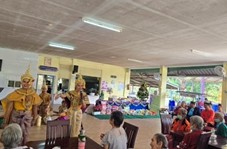
This research aimed to: (1) examine body movements in relation to the emotional expressions of older adults, (2) create Pleng Song Khrueang (a traditional Thai musical theatre form) to promote mental health among older adults, and (3) investigate the level of satisfaction ofolder adults with the developed performance pieces. The participants were 18 older adults
residing at a Social Welfare Development Center for Older Persons. Research instruments included a movement observation form, the WHO-5 Well-Being Index, and a satisfaction questionnaire.
The findings revealed that: (1) older adults demonstrated a statistically significant increase in positive emotions and a decrease in negative emotions. Open postures, dynamic arm–hand movements, and wide ranges of movement were positively correlated with positive emotions. (2) Pleng Song Khrueang compositions were created, embedding messages that promote mental well-being, such as optimism, empowerment, and harmonious coexistence. When implemented, these compositions resulted in a significant increase in mental health scores among older adults. (3) Participants expressed a high level of satisfaction with the performances, particularly in terms of enjoyment and participation. The results indicate that creative Pleng Song Khrueang can serve as an effective performing arts tool to enhance mental health and quality of life among older adults. Moreover, it reflects cultural values that can be extended and applied at community and societal levels.
Article Details

This work is licensed under a Creative Commons Attribution-NonCommercial-NoDerivatives 4.0 International License.
All authors must take public responsibility for the content of their paper. The WIPIT Journal Editors will not be taking any public responsibility for the content in the paper.
References
กรมอนามัย กระทรวงสาธารณสุข. (2560). ผู้จัดการการดูแลสุขภาพผู้สูงอายุ. Online Available:http://www.anamai.moph.go.th/main.php?filename=Test_Index_2014
กรมอนามัย. (2560). รายงานสถานการณ์สุขภาพผู้สูงอายุในประเทศไทย. กรุงเทพฯ: กรมอนามัย กระทรวงสาธารณสุข.
จิราพร ศรีสวัสดิ์ และคณะ. (2566). กิจกรรมศิลปะบำบัดกับคุณภาพชีวิตผู้สูงอายุ. กรุงเทพฯ.
พรพิมล อินทร์อ่อน. (2565). การใช้ศิลปะพื้นบ้านเพื่อส่งเสริมสุขภาพจิตผู้สูงอายุ. กรุงเทพฯ: บัณฑิตวิทยาลัย.
ภคณิช ต่วนชะเอม. (2545). ผลของกลุ่มระลึกความหลังที่มีต่อการเห็นคุณค่าในตนเองของผู้สูงอายุในสถานสงเคราะห์คนชรา. ปริญญานิพนธ์ วท.ม. (จิตวิทยาการให้คำปรึกษา). ชลบุรี: บัณฑิตวิทยาลัย มหาวิทยาลัยบูรพา.
สุภาวดี แสงจันทร์ และคณะ. (2564). การใช้รำวงพื้นบ้านเพื่อส่งเสริมสุขภาพจิตผู้สูงอายุ. เข้าถึงได้จาก https://nuir.lib.nu.ac.th/dspace/bitstream/123456789/5718/3/SalintipMontiean.pdf
อเนก หงษ์ทองคำ. (2542). จิตวิทยาการดำเนินชีวิต. ภาควิชาสันทนาการ คณะพลศึกษา มหาวิทยาลัยศรีนครินทรวิโรฒ. กรุงเทพฯ.
อัจศรา ประเสริฐสิน และคณะ. (2561). สุขภาวะของผู้สูงอายุ: แนวคิดและปัจจัยที่เกี่ยวข้อง. วารสารสุขศึกษา. 41: 1 (มกราคม – มิถุนายน). 1-15.
อาชัญญา รัตนอุบล. (2551). การดูแลผู้สูงอายุเชิงองค์รวม. เข้าถึงได้จาก https://search.tci-thailand.org/article.html?b3BlbkFydGljbGUmaWQ9MTM4NjQx
อุมา สีดี. (2565). สุขภาพจิตและศิลปะบำบัด. เข้าถึงได้จาก https://ir.stou.ac.th/bitstream/123456789/13169/1/2632800534.pdf
Adams, J., & others. (2000). Wellness and health promotion. pp. 165–173. New York: Publisher.
Basting, A. D. (2009). Forget memory: Creating better lives for people with dementia. Baltimore: Johns Hopkins University Press.
Buck, R., Hartsack, J., & Gaffney, S. (1985). Nonverbal communication and emotion. Journal Name, volume(issue), pages.
Chanthaket P., Katisart T., Luang-In V. Foods Journal (2022). Phytochemical ... Tropical Journal of Natural Product Research, 2022, 6(6).
Coughlan, R. (1994). Psychological well-being and aging. Journal Name, volume(issue), pages.
Dossey, B. M., Keegan, L., Guzzeta, C. E., & Kolmeier, L. G. (1995). Holistic nursing. New York: Aspen Publishers.
Ebersole, P., & Hess, P. (as cited in ภคณิช ต่วนชะเอม, 2545). Toward healthy aging.
Knowles, M. S. (1984). Andragogy in action: Applying modern principles of adult learning. Jossey- Bass.
Koch, S. C., Kunz, T., Lykou, S., & Cruz, R. (2014). Effects of dance movement therapy and dance on health-related psychological outcomes: A meta-analysis. The Arts in Psychotherapy, 41(1), 46–64. https://doi.org/10.1016/j.aip.2013.10.004
Koch, S. C., Riege, R. F. F., Tisborn, K., Biondo, J., Martin, L., & Beelmann, A. (2019). Embodied aesthetics: A review of the neuropsychological foundations of embodied aesthetics and its implications for dance movement therapy. Frontiers in Psychology,
, 2094. https://doi.org/10.3389/fpsyg.2019.02094
Lee, J., & Lee, H. (2021). The effects of traditional music-based activities on mental health and social participation of older adults. Journal of Music Therapy, 58(3), 321– 340.
Payne, H. (2006). Dance movement therapy: Theory, research and practice. Routledge.
World Health Organization. (1989). Health promotion glossary. Geneva: WHO.
World Health Organization. (2019). What is the evidence on the role of the arts in improving health and well-being? WHO Regional Office for Europe.
