
Alternative Harmony Using Axisymmetric Theory in Music Composition
Article Sidebar
Main Article Content
Abstract
Music in the tonal music system is a sound system that the world society has been familiar with for many years because music is an art that imitates only some parts of the outside world, used together with the creator's intelligence, thoughts, and feelings. Imitation of the familiar, which has become familiar, has led to change, making the ideas of 20th century artists try to create something different from the original by introducing new techniques and methods into their compositions in all dimensions, such as asymmetrical songs, which are movements that are difficult to predict or even unpredictable. It is a concept in art that means anything that can stimulate aesthetic emotions; it is considered a work of art. By integrating three main principles of art psychology, namely the theory of imitation (Theory of Representation), the theory of arousal (Arousal Theory), entering the dopamine cycle (Dopamine) by stimulating the desire to find something difficult to predict (Unexpected) that helps increase goal-directed behaviour more than usual.
With the axis of symmetry system as an alternative harmonic creation system for future song composition, the principles of the axis of symmetry theory have techniques that have the properties to stimulate aesthetic emotions. When analyzed as a principle of composition methods, it can be set as a preliminary observation to answer in four points.
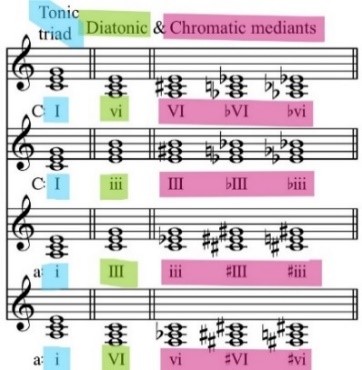
1) Using familiar musical art methods as the main element by developing from the tone that follows the function of the chord (Functional Tonality) by expanding the concept of composition methods from an emotional perspective of the relationship between the chord axis and the diatonic median method, consistent with the concept of imitation theory. 2) Using the art music approach by using chord types to create stimuli by adding or reducing notes outside the chord to the three main chord functions, including tonic chords, subdominant chords, and dominant chords, and developing them into a method of using the principles of counter pole system symmetry, consistent with the concept of stimulation theory. 3) The use of unpredictable and inquisitive musical approaches as the main concept by developing from non-functional tonality, expanding the concept of chromatic mediation and back door progression in line with the dopamine cycle method. 4) The axis of the symmetry system can create changes in contemporary music in the future. Creating new roles that will lead to future progress, increasing structural complexity and the axis of symmetry theory can expand the scope of thought by creating differences from familiarity. Combining the concepts of artistic psychology in 3 main principles: imitation theory, stimulation theory, creating a method that is difficult to predict, and the concept of composition theory, which is consistent with the progress of the song, will help stimulate interest in creative songs in the future.
Article Details

This work is licensed under a Creative Commons Attribution-NonCommercial-NoDerivatives 4.0 International License.
All authors must take public responsibility for the content of their paper. The WIPIT Journal Editors will not be taking any public responsibility for the content in the paper.
References
ณัชชา พันธุ์เจริญ. (2552). พจนานุกรมศัพท์ดุริยางคศิลป์ (พิมพ์ครั้งที่ 3). เกศกะรัต.
ปุณณรัตน์ พิชญไพบูลย์. (2561). จิตวิทยาศิลปะสุนทรียศาสตร์เชิงประจักษ์ (พิมพ์ครั้งที่ 2). โรงพิมพ์แห่งจุฬาลงกรณ์มหาวิทยาลัย.
วิบูลย์ ตระกูลฮุ้น. (2558). ดนตรีศตวรรษที่ 20. สำนักพิมพ์แห่งจุฬาลงกรณ์มหาวิทยาลัย.
ราชบัณฑิตยสภา. (2561). พจนานุกรมดนตรีสากล. ศรีเมืองการพิมพ์.
วีรชาติ เปรมานนท์. (ม.ป.ป.). ปรัชญาและเทคนิคการแต่งเพลงร่วมสมัยไทย. คณะศิลปกรรมศาสตร์, จุฬาลงกรณ์มหาวิทยาลัย.
Weinschenk, S. M. (2018). 100 things every designer needs to know about people [100 เคล็ดลับจิตวิทยาสำหรับคนที่อยากออกแบบให้เข้าถึงใจคน]. WeLearn.
