
Tigaraya Pattani, The Choreography
Article Sidebar
Main Article Content
Abstract
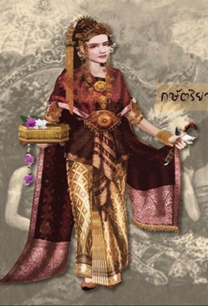
The Choreography named Tigaraya Pattani is a part of the thesis for fourth-year students in the performing arts department of the Faculty of Fine and Applied Arts, Suan Sunandha Rajabhat University, Thailand. The goal is to create and design dance performances that are a result of creative research. The students use the concepts and theories of choreographic creation combined with dance practice and analyze the collected data to create a dance performance.
The research showed that the Patani Kingdom was governed by three distinct kings named Rayahiyao, Rayabiru, and Rayaungu. Each of these rulers had a unique identity and was responsible for leading the Patani Kingdom to its most distinguished period of prosperity during the Lankasuka era. Tigaraya Pattani was inspired by this history and comprises seven crucial elements: (1) concept, (2) performers, (3) songwriting, (4) choreography, (5) costume design, (6) space design, and (7) props. This performance is unique in its use of Mayong gestures and its music, a Patani royal dance combined with the dance style of the lower southern region of Thailand, presented as traditional, creative southern dance. Tigaraya Pattani is a series of performances with educational benefits, especially in creating dance works to honour ancestors. This performance encourages awareness among the local youth about the significance of the history of indigenous people. The lifestyle of the local area is expressed in various forms, including beliefs, way of life, dress, arts, and culture, which are valuable cultural heritages and should be taken care of well to avoid fading from people’s memory.
Article Details

This work is licensed under a Creative Commons Attribution-NonCommercial-NoDerivatives 4.0 International License.
All authors must take public responsibility for the content of their paper. The WIPIT Journal Editors will not be taking any public responsibility for the content in the paper.
References
จิระเดช นุกูลโรจน์. (2562). “กระบวนการสร้างสรรค์ระบำพื้นบ้านมลายูภาคใต้ คณะอัสลีมาลา”. Trends of Humanities and Social Sciences Research, 7(2), 156-179.
จุฑารัตน์ ปานผดุง. (2563, 21 กันยายน). กษัตริยาแห่งปัตตานี. PATTANIHERITAGECITY. https://shorturl.asia/rSpDN
ชาดา นนทวัฒน์. (2557). สี่กษัตริยาแห่งปาตานี อานาจ การเมือง การค้า และโจรสลัดบนแผ่นดินใต้สายลม. ยิปซี.
ณัฏฐนันท์ จันนินวงศ์ และ ผุสดี หลิมสกุล. (2557). “การออกแบบลีลานาฏศิลป์ไทยของอาจารย์สุวรรณี ชลานุเคราะห์ ศิลปินแห่งชาติ ปี พ.ศ. 2533” วารสารศิลปกรรมศาสตร์ จุฬาลงกรณ์มหาวิทยาลัย, 1(1), 32 - 39.
ดัชนีย์ ทองแกมแก้ว และ ทัศนียา คัญทะชา. (2555). “ตารีลีเล็ง: ระบำเทียนระบำพื้นบ้านไทยมุสลิมภาคใต้ ผลงานสร้างสรรค์จากจินตนาการของศิลปินพื้นบ้าน: เซ็ง อาบู”. RUSAMILAE JOURNAL, 33(3), 19–32.
ประพนธ์ เรืองณรงค์. (2563, 26 ตุลาคม). มะโย่ง. CLIB.PSU. https://clib.psu.ac.th/southerninfo/content/2/9e22cecf
มนัญชยา เพชรูจี. (2564). นาฏยประดิษฐ์ ชุด มัทรีทรงเครื่อง. วารสารมนุษยศาสตร์และสังคมศาสตร์ มหาวิทยาลัยราชภัฏอุดรธานี, 10(2), 1 - 16.
วลัยลักษณ์ ทรงศิริ. (2559, 3 มิถุนายน). “ ปาตานี ” นครแห่งความทรงจำ. LEK-PRAPAI. https://lek-prapai.org/home/view.php?id=195.
อับดุลรากิ๊บ บินนิฮัสซัน. (2551). ปัตตานีกับโลกมลายู และตำนานปาตานี. มูลนิธิโตโยต้าประเทศไทย,มูลนิธิโครงการตำราสังคมศาสตร์และมนุษยศาสตร์.
Dijkstra, Katinka; Zwaan, Rolf A. (2014). “Memory and action”. Routledge Handbook of Embodied Cognition. pp. 314–323.
Wilson, M. (2002). Six views of embodied cognition. Psychonomic Bulletin & Review 9, 625–636. https://doi.org/10.3758/BF03196322.
