
The Use of Common Notes Leading to Popular Music Harmony
Article Sidebar
Main Article Content
Abstract
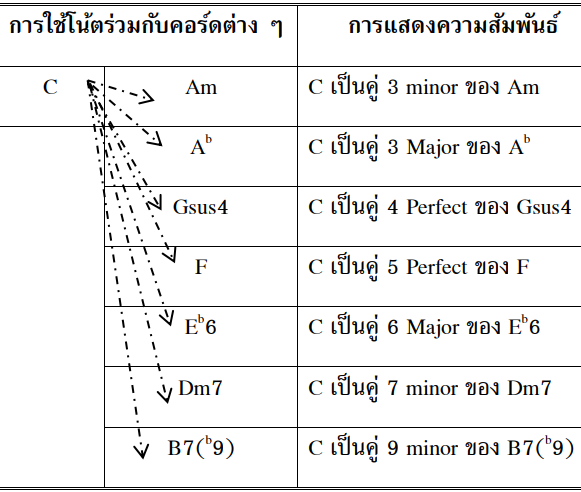
This academic article aims to present a practical concept applying classical harmony and jazz harmony theory to popular music. The concept and methods of musical harmony in classical and jazz music are related. However, there needs to be an appropriate way to apply both concepts in practical usage. Therefore, the proposed method uses “common notes” as a basic concept to be applied to the musical harmony in both classical and jazz. From the concept mentioned, the author has proposed the guideline to observe and analyse music leading to the creation of musical aesthetics, which is different to mainstream music effectively. Also, it could be applied to the modern trend of making music through musical experiments and the arrival trend of music in the future.
The finding of the paper has shown that the use of common notes is the method of using joint notes to connect to the piece. On the one hand, to make the harmonious, diatonic substitution found in classical and jazz music should be applied to enhance the peaceful and accordant tone in music. On the other hand, to make the spectacular tone in the piece, the suitable theory should be a chromatic substitution. However, both dimensions of applying the common notes based on the theories of harmony should have functioned under the individual music experiences in order to cultivate mutual aesthetics in society.
Article Details

This work is licensed under a Creative Commons Attribution-NonCommercial-NoDerivatives 4.0 International License.
All authors must take public responsibility for the content of their paper. The WIPIT Journal Editors will not be taking any public responsibility for the content in the paper.
References
จักรวาล สุขไมตรี. (2561). เทคนิคการประสานงานในองค์การ. วารสารวิชาการแพรวากาฬสินธุ์, 5(2), 263 - 275. http://praewa.ksu.ac.th/new2017/file/20180704_7106484980.pdf
ณรงค์ฤทธิ์ ธรรมบุตร. (2552). การประพันธ์เพลงร่วมสมัย. สำนักพิมพ์แห่งจุฬาลงกรณ์มหาวิทยาลัย.
ณัชชา พันธุ์เจริญ. (2551). สังคีตลักษณ์และการวิเคราะห์. (พิมพ์ครั้งที่ 4). เกศกะรัต.
เด่น อยู่ประเสริฐ. (2555). การประพันธ์ดนตรีแจ๊ส. (พิมพ์ครั้งที่ 4). สำนักพิมพ์มหาวิทยาลัยรังสิต.
ราชบัณฑิตยสภา. (2561). พจนานุกรมดนตรีสากล. ศรีเมืองการพิมพ์.
วิบูลย์ ตระกูลฮุ้น. (2550). ทฤษฏีดนตรี 3. (พิมพ์ครั้งที่ 2). สำนักพิมพ์มหาวิทยาลัยรังสิต.
วีรชาติ เปรมานนท์. (ม.ป.ป.). ปรัชญาและเทคนิคการแต่งเพลงร่วมสมัยไทย. คณะศิลปกรรมศาสตร์จุฬาลงกรณ์มหาวิทยาลัย.
ศักดิ์ศรี วงศ์ธราดล. (2555). ทฤษฏีดนตรีแจ๊ส เล่ม 1. วงศ์สว่างพับลิชชิ่ง แอนด์ พริ้นติ้ง.
ศักดิ์ศรี วงศ์ธราดล. (2558). ทฤษฏีดนตรีแจ๊ส เล่ม 2. มิสชั่น มีเดีย.
สมชาย รัศมี. (2536). คู่มือนักดนตรี. พรานนกการพิมพ์.
สุรพงษ์ โสธนะเสถียร. (2559). ทฤษฎีการสื่อสาร. (พิมพ์ครั้งที่ 3). ระเบียงทอง.
อนรรฆ จรัณยานนท์. (2537). เค้าน์เตอร์พ้อยท์. โอ.เอส.พริ้นติ้ง เฮ้าส์.
อานนท์ ศิริสมบัติวัฒนา. (ม.ป.ป.). THE JAZZ THEORY FIRST EDITION [เอกสารที่ไม่มีการตีพิมพ์]. อานนท์การดนตรี.
