
Leadership of Women by Culture in the 21st Century
Article Sidebar
Main Article Content
Abstract
This academic article presents the cultural identity of worldwide female leadership by examining controversial gender issues between men and women in different cultures. This article also displays the government's efforts at resolving inequality of these issues in different countries. Moreover, the impact of digital technology in the 21st century that affects the feminist movement through social media was discussed in this article as well as the proposed government's future campaigns to empower and support feminist equality corresponding to an ongoing global trend embraced with the new digital technology and globalization.
Article Details

This work is licensed under a Creative Commons Attribution-NonCommercial-NoDerivatives 4.0 International License.
All authors must take public responsibility for the content of their paper. The WIPIT Journal Editors will not be taking any public responsibility for the content in the paper.
References
เกรียงศักดิ์ เขียวยิ่ง. (2550). การบริหารทรัพยากรมนุษย์. เอ็กซ์เปอร์เน็ท.
ชญารัศมิ์ ทรัพยรัตน์ และ ประพันธ์ ชัยกิจอุราใจ. (2556). พฤติกรรมการเป็นสมาชิกที่ดีขององค์การกับผลลัพธ์ที่เกิดขึ้น. วารสารวิชาการมหาวิทยาลัยฟาร์อีสเทอร์น, 7(1), 7 – 22. https://so01.tci-thaijo.org/index.php/FEU/article/view/24713
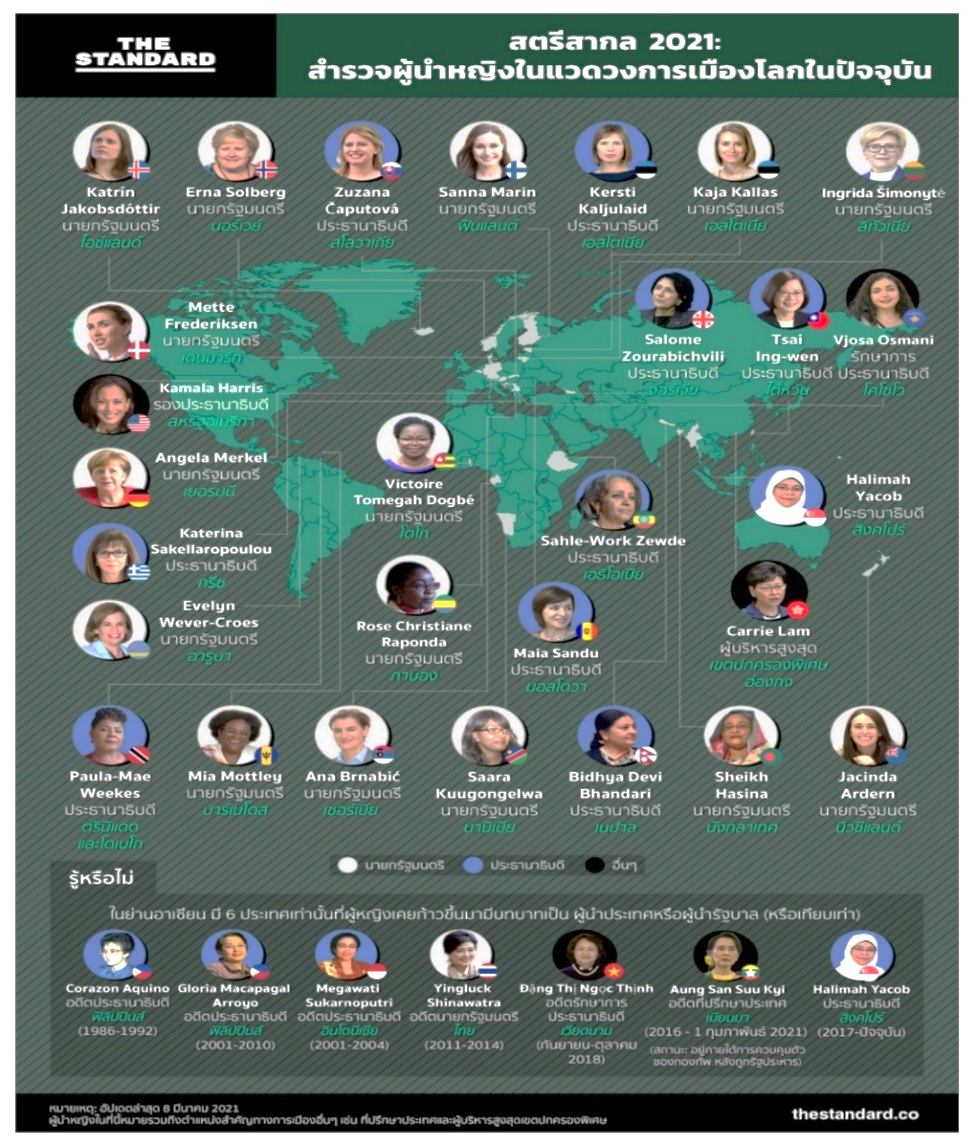
ณรงค์กร มโนจันทร์เพ็ญ. (2564, 8 มีนาคม). สตรีสากล 2021: สำรวจผู้นำหญิงในแวดวงการเมืองโลกปัจจุบัน. THE STANDARD STAND UP FOR THE PEOPLE. https://thestandard.co/international-womens-2021-female-leaders-in-global-political/
บุญฑวรรณ วิงวอน และ มนตรี พิริยะกุล. (2553). ตัวแบบเส้นทาง PLS ของบุพปัจจัยและผลลัพธ์ของการรับรู้ในการสนับสนุนจากองค์กรของพนักงานวิสาหกิจขนาดกลางและขนาดย่อม จังหวัดลำปาง. http://www.research.ru.ac.th/images/ArticleMr/1501822764_Article.pdf
ปรรณวัฒน์ ชูวิเชียร. (2562). บทบาทของพรรคประชาธิปัตย์ในการส่งเสริมการมีส่วนร่วมทางการเมืองของนักการเมืองสตรีในรัฐสภา. วารสารการวิจัยการบริหารการพัฒนา, 9(3), 96 – 103. https://so01.tci-thaijo.org/index.php/JDAR/article/view/244019/165387
พระมหาวุฒิชัย วุฑฒิชโย, พระมหาบุญรอด อมรทตุโต, กฤษณะ เชี่ยวเวช และ พระครูเกษมอรรถากร. (2565). สิทธิสตรีกับการปกครองระบอบประชาธิปไตย. วารสารพุทธมัคค์ ศูนย์จริยธรรมศึกษา, 7(1), 282 - 296. https://so01.tci-thaijo.org/index.php/bdm/article/view/256872/170729
สุวิทย์ เมษินทรีย์. (2563). โลกเปลี่ยน คนปรับ หลุดจากกับดัก ขยับสู่ความยั่งยืน. กระทรวงการอุดมศึกษาวิทยาศาสตร์ วิจัยและนวัตกรรม.
เสริมศักดิ์ วิศาลาภรณ์. (2536). ประมวลสาระชุดวิชาทฤษฎีและแนวปฏิบัติในการบริหารการศึกษา หน่วยที่ 5 – 8. สำนักพิมพ์มหาวิทยาลัยสุโขทัยธรรมาธิราช.
Al-Jaradat, M.K.M. (2014). Challenges Facing Women Academic Leadership in Secondary Schools of Irbid Educational Area. International Education Studies, 7(5), 147-106. https://files.eric.ed.gov/fulltext/EJ1069310.pdf
Bass, B.M. (1990). Bass and Stogdill’s Handbook of Leadership: Theory, Research and Managerial Applications, 3rd ed. Free press.
Bem, S. L. (1993). The lenses of gender: Transforming the debate on sexual in equality. Yale University Press.
Bateman, T.S., & Organ, D.W. (1983). Job satisfaction and the good soldier: the relationship between affect and citizenship. Academy of Management Journal, 26(4), 587-595. https://www.jstor.org/stable/255908
Blevins, K. (2018). Bell hooks and Consciousness-Raising: Argument for a Fourth Wave of Feminism. In: Vickery, J. Everbach, T. (eds) Mediating Misogyny. Palgrave Macmillan, Cham.
Chamberlain, P. (2017). The Feminist Fourth Wave: Affective Temporality. Palgrave Macmillan, Springer International Publishing AG. Switzerland.
Chodorow, N. J. (1991). Feminism and psychoanalytic theory. Yale University Press.
Gilligan, C. (1982). In a different voice: Psychological theory and women's development. Harvard University Press.
Google Developers. (2017). Past, Present and Future of AI/ Machine Leaning (Google I/O’17). YouTube. https://www.youtube.com/watch?v=0ueamFGdOpA
Grid Alternatives. (2013, 12 November). Erica Mackie Honored for Energy Leadership. https://goo.gl/VWEqB7
Kaye, D. B. V., Zeng, J., & Wikstrom, P. (2022). TikTok: Creativity and Culture in Short Video. Cambridge, Polity Press.
Khattab, J., & Rosette, A. S. (2017). Workplace barriers faced by women leaders in emerging markets. Women Leadership in Emerging Markets: Featuring 46 Women Leaders.
Lavelle, J. J., Rupp, E. D., & Brockner, J. (2007). Taking a Multifoci Approach to the Study of Justice, Social Exchange, and Citizenship Behavior: The Target Similarity Model. Journal of Management, 33(6), 841 – 866. https://journals.sagepub.com/doi/10.1177/0149206307307635
Lixian, H. (2015). On Fire in Weibo: Feminist Online Activism in China. Economic and Political Weekly, 50(17), 79 – 85.
Miller, D., & Droge, C. (1986). Psychological and Traditional Determinants of Structure. Administrative Science Quarterly, 31(4), 539 – 560.
O’Leary, V. E., & Flanagan, E. H. (2006). Leadership In J. Worell (Ed.). Encyclopedia of women and gender: Sex similarities and differences and the impact of society on gender. Elsevier Science & Technology.
Promnart, P. (2015). Modern Women, Modern Man: The Discursive Construction of Sexual Propriety In Sixth-Reign Siam (1910 – 1925). National University of Singapore.
Women Mthai Team (2557, 16 มีนาคม). ผู้หญิงยุคใหม่กับความก้าวหน้าในอาชีพ โดย เชอริล แซนด์เบิร์ก ซีโอโอ เฟซบุ๊ก. MTHAI. https://women.mthai.com/amazing-women/156791.html
Shim, J. (2018). Mind the Gap! Comparing Gender Politics in Japan and Taiwan. GIGA Focus Asia. GIGA. https://pure.giga-hamburg.de/ws/files/21580585/gf_asien_1805_en.pdf
Tsai, C. T. L., & Zhou, L. (2015). A Cultural Confrontation: Western Impacts on Female College Students’s Leisure Opportunities in Taiwan and China. Social Indicators Research., 120(1), 261 – 276. https://www.jstor.org/stable/24721109
United Nations Development Programme. (2013, 3 June). Women’s Representation in Leadership in Vietnam. https://www.undp.org/vietnam/publications/women%E2%80%99s-representation-leadership-viet-nam
World Economic Forum. (2020). Global Gender Gap Report 2020. World Economic Forum.
https://www3.weforum.org/docs/WEF_GGGR_2020.pdf
Xing, M., & Pang, M. (2018). A Cross - Cultural Examination of Chinese and American Female Leadership in Nonprofit Organizations. China Media Research, 14(1), 30-41. https://www.researchgate.net/publlication/323151258
Yeates, N. (2004). Global Care Chains. International Feminist Journal of Politics, 6(3), 369 – 391.
Yukl, G. A. (1989). Leadership in Organizations. Englewood Cliffs. Prentice – Hall.
