
The Creative Performance of “Sattasahai Tossakan”
Article Sidebar
Main Article Content
Abstract
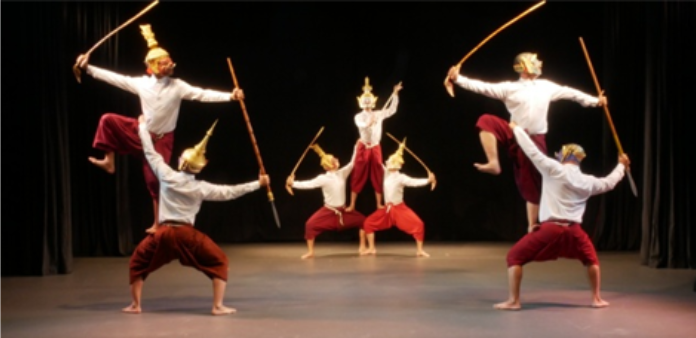
This research aims to study the attributes and the Tossakan’s friends (the seven demon characters) to create the performance called Sattasahai Tossakan. The qualitative research methods were used to create the performance demonstrating the roles, abilities, and personalities of the demon characters.
The result shows that: 1) characteristics and roles of these seven Tossakan’s friends, including Thao Chakkrawat, Thao Atsakan, Thao Phaichittrasun, Thao Satthasun, Thao Mun-la-phlam, Thao Sattalung, and Thao Mahaban. Each character has different characteristics and roles according to what appears in the Ramakian epic: possing love and the urge for vengeance for their friend, so much that they lost their mindfulness to consider the cause of the fight carefully. Governed by their compassion for their friend, they embarked on a war in the hope to eliminate Rama, which eventually led to their death. 2) the creation of Sattasahai Tossakan performance is based on structural feature which is divided into three parts: the beginning part representing the gathering of seven demons, the content part describing physical features and characteristics of the characters, and the conclusive part demonstrating the strength and readiness to mobilise for war with Rama to avenge the wrath of Tossakan, their beloved friend. The dance forms are the integration of the different dance forms and movements that behaviourally move according to those described in the literature and outstandingly differ from one another. The casting of performers is based on basic qualities of performers who are physically strong, possess the satisfactory dancing skill, and are responsive. Regarding the musical accompaniment of this performance, both pieces and lyrics represent a demonstration of power, arrogance, and strength. There are the pieces as follows: Pathom, Tung-Ting, Trabong-Kan, Krao Nai, and Choet. The choreography exhibits new and outstanding dance forms with characters that are rarely observed and recognised as Tossakan's friends. These reasons were the cause that inspired the researcher to gather all features to be appeared in the lyrics of the performance to create Sattasahai Tossakan.
Article Details
All authors must take public responsibility for the content of their paper. The WIPIT Journal Editors will not be taking any public responsibility for the content in the paper.
References
จุลชาติ อรัณยะนาค. (2562). การสร้างสรรค์การแสดง ชุด สัตตะสหายทศกัณฐ์. [เอกสารไม่ตีพิมพ์]. รายงานการวิจัยสร้างสรรค์ ประจำปีงบประมาณ พ.ศ. 2562 สถาบันบัณฑิตพัฒนศิลป์.
ธรากร จันทนะสาโร. (2557). นาฏยศิลป์จากแนวคิดไตรลักษณ์ในพระพุทธศาสนา. สำนักพิมพ์แห่งจุฬาลงกรณ์มหาวิทยาลัย.
พุทธยอดฟ้าจุฬาโลก, พระบาทสมเด็จพระ. (2540). บทละครเรื่องรามเกียรติ์ พระราชนิพนธ์ในพระบาทสมเด็จพระพุทธยอดฟ้าจุฬาโลกมหาราช เล่ม 1-4. กรมศิลปากร.
ไพโรจน์ ทองคำสุก. (2548). ครูเสรี หวังในธรรม ศิลปินแห่งชาติ รูปแบบความเป็นครูผู้ถ่ายทอด และสร้างสรรค์นาฏศิลป์ไทย. สำนักการสังคีต กรมศิลปากร.
มนตรี ตราโมท. (ม.ป.ป.). การผสมวง. สารานุกรมไทยสำหรับเยาวชน โดยพระราชประสงค์ในพระบาทสมเด็จพระบรมชนกาธิเบศร มหาภูมิพลอดุยเดชมหาราช บรมนาถบพิตร เล่มที่ 1 เรื่องที่ 9 ดนตรีไทย. https://www.saranukromthai.or.th/sub/book/book.php?book=1&chap=9&page=t1-9-infodetail02.html
มโน พิสุทธิรัตนนานนท์. (2540). สุนทรียศาสตร์เบื้องต้น. ภารกิจเอกสารและตำรา มหาวิทยาลัยทักษิณ.
สมศักดิ์ ทัดติ. (2540). จารีตการฝึกหัด และการแสดงโขนของตัวทศกัณฐ์. [วิทยานิพนธ์มหาบัณฑิต]. Chulalongkorn University Intellectual Repository (CUIR). http://cuir.car.chula.ac.th/handle/123456789/9832
สุรพล วิรุฬห์รักษ์. (2543). นาฏยศิลป์ปริทรรศน์. ภาควิชานาฏศิลป์ คณะศิลปกรรมศาสตร์ จุฬาลงกรณ์มหาวิทยาลัย.
สุรพล วิรุฬห์รักษ์. (2547). หลักการแสดงนาฏยศิลป์ปริทรรศน์. สำนักพิมพ์แห่งจุฬาลงกรณ์มหาวิทยาลัย.
Nattasampum. (2560, 19 มีนาคม). สัตตะสหายทศกัณฐ์ ผลงานนาฏศิลป์สร้างสรรค์ ของ ผศ.ดร.จุลชาติ อรัณยะนาค. https://www.youtube.com/watch?v=eekT-nLk6wA
