
Evaluating the Energy Efficiency of Hollow Precast Walls with Integrated Active Ventilation using the EDGE Certification Framework and Application
Article Sidebar
Main Article Content
บทคัดย่อ
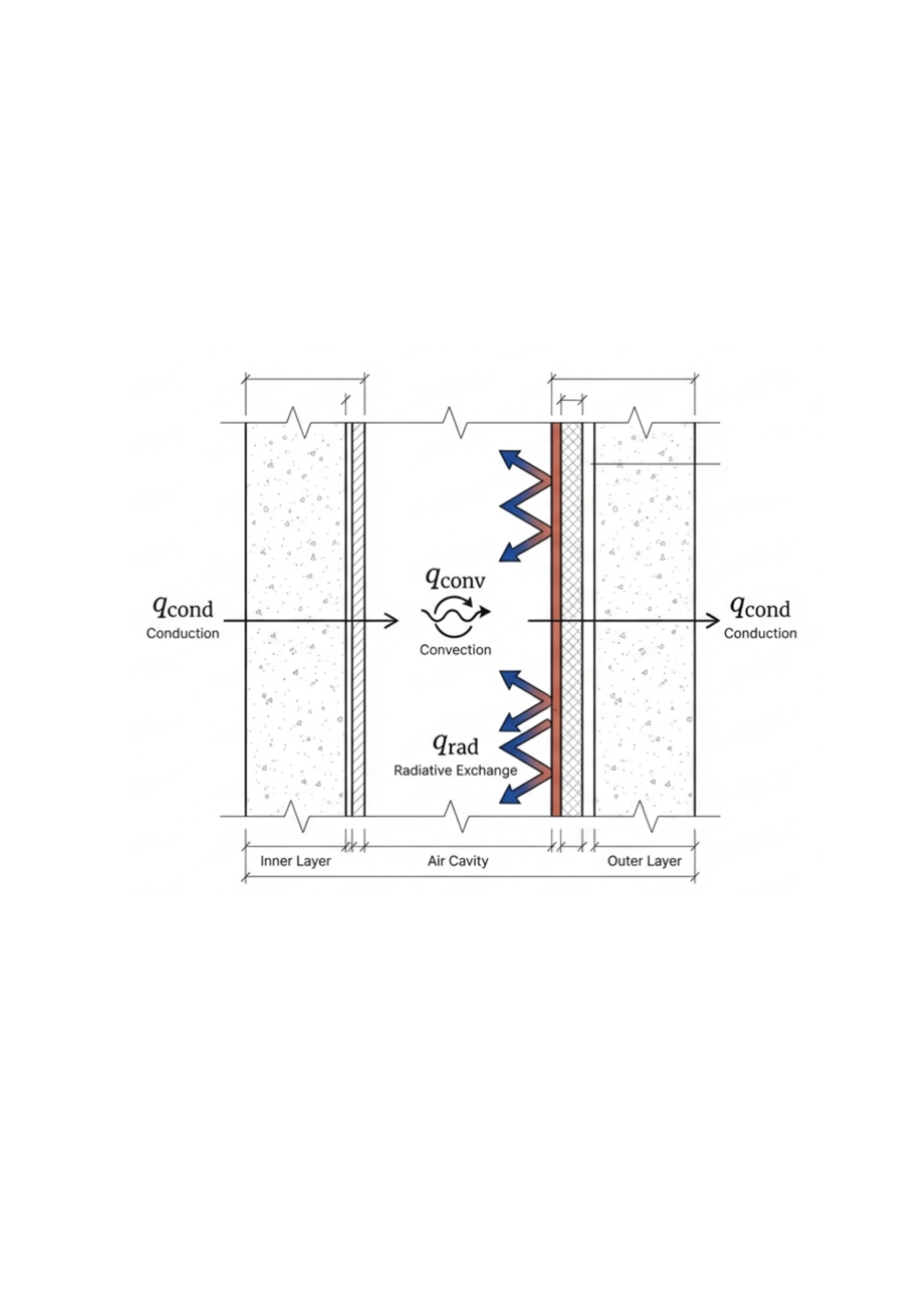
This study evaluates the thermal and energy performance of an Active Double-Layered Precast Wall (ADLP) system for buildings in hot–humid climates using the EDGE (Excellence in Design for Greater Efficiencies) certification framework. While airflow-assisted wall systems can reduce heat transfer and cooling demand, their dynamic thermal behavior cannot be directly represented within the standard EDGE methodology. This study proposes a practical approach for translating airflow-dependent thermal performance into equivalent U-values compatible with EDGE energy assessment. The ADLP system incorporates a hollow cavity with controlled upward airflow to enhance convective heat removal and reduce heat gain through the building envelope. Analytical heat-transfer modeling and transient thermal analysis were used to evaluate wall performance under three airflow conditions: 0 m/s, 0.1 m/s, and 1.0 m/s. The resulting equivalent U-values were then applied within the EDGE App to assess whole-building energy performance for a two-storey residential building in Bangkok, Thailand. Results indicate that the effective wall U-value decreased from 0.590 W/m²·K under the unventilated condition to 0.256 W/m²·K and 0.177 W/m²·K at airflow velocities of 0.1 m/s and 1.0 m/s, respectively. Corresponding annual energy savings increased from 7.23% to 9.35% and 9.85%. The findings suggest that cavity ventilation can improve envelope thermal performance and reduce cooling-energy demand. The study presents a methodology for integrating active wall systems into certification-oriented energy assessments and supports the application of airflow-assisted envelopes in tropical climates.
Article Details

อนุญาตภายใต้เงื่อนไข Creative Commons Attribution-NonCommercial-NoDerivatives 4.0 International License.
เอกสารอ้างอิง
Chantawong, P., Hirunlabh, J., Zeghmati, B., Khedari, J., Teekasap, S., & Win, M. M. (2006). Investigation on thermal performance of glazed solar chimney wall. Solar Energy, 80(3), 288–297. https://doi.org/10.1016/j.solener.2005.02.015
Condezo-Solano, M. J., Erazo-Rondinel, A. A., Barrozo-Bojorquez, L. M., Rivera-Nalvarte, C. C., & García-Puclla, A. Z. (2024). Analysis of the impact of EDGE certification on buildings: The case of Peru. Revista Hábitat Sustentable, 14(1), 66–79. https://doi.org/-10.22320/07190700.2024.14.01.05
Cuce, P. M., & Cuce, E. (2025). Ventilated facades for low-carbon buildings: A review. Processes, 13(7), 2275. https://doi.org/10.3390/pr13072275
Domínguez-Torres, C.-A., León-Rodríguez, Á. L., Suárez, R., & Domínguez-Delgado, A. (2022). Empirical and Numerical analysis of an opaque ventilated Fa¬cade with windows openings under Mediterranean climate conditions. Mathematics, 10(1), 163. https:// doi.org/10.3390/math10010163
Donn, M. (2025). Simulation and the building performance gap. Buildings and Cities, 6(1), 713–728. https://doi.org/10.5334/bc.688
EDGE. (2025). User documents. EDGE Buildings. https://edgebuild¬ings.com/resou-rces/ser-documents/
Fawaier, M., & Bokor, B. (2022). Dynamic insulation systems of building enve¬lopes: A review. Energy and Buildings, 270, 112268. https://doi.org/-10.1016/j.enbuild.2022.112268
Gregório-Atem, C., Aparicio-Fernández, C., Coch, H., & Vivancos, J.-L. (2020). Opaque ventilated façade (OVF) thermal performance simulation for of¬fice buildings in Brazil. Sustainability, 12(18), 7635. https://doi.org/10.3390/su12187635
Huang, J., Yu, J., & Yang, H. (2018). Effects of key factors on the heat insulation performance of a hollow block ventilated wall. Applied Energy, 232, 409–423. https://doi.org/10.10-16/j.apenergy.2018.09.215
IFC. (2021). EDGE methodology version 3.0. International Finance Corporation.
Incropera, F. P., DeWitt, D. P., Bergman, T. L., & Lavine, A. S. (2007). Fundamentals of heat and mass transfer (6th ed.). John Wiley & Sons.
Laken, J., & Fowler, J. R. (2008). Harnessing thermal mass with precast concrete construction. Energy Engineering, 105(2), 7–23.
Lim, Y., & Ismail, M. R. (2023). Thermal and energy influences of double skin façade towards green buildings in tropical classified countries. Journal of Advanced Research in Fluid Mechanics and Thermal Sciences, 109(2), 1–26. https://doi.org/10.37934/arfmts.-109.2.126
Phaiboonnukulkij, K. (2025). The Design and assessment of the hollow precast wall with integrated active ventilation system, for minimizing heat reten¬tion, Removing Heat Load. Journal Innovation of Civil Engineering (JICE), 6(2), 170–193. https://doi.org-/10.33474/jice.v6i2.23939
Pujadas-Gispert, E., Alsailani, M., van Dijk, K. C. A., Rozema, A. D. K., ten Hoope, J. P., Korevaar, C. C., & Moonen, S. P. G. (2020). Design, construction, and thermal performance evaluation of an innovative bio-based ventilated façade. Frontiers of Architectural Research, 9(3), 681–696. https://doi.org/10.1016/j.foar.2020.02.003
Rahmani, S., Ahmad, A. S., & Lim, Y. W. (2012). The effects of double-skin façade on energy consumption and thermal comfort in the tropical climate of Malaysia. Indoor and Built Environment, 21(3), 356–367.
Ratanachotinun, J., & Pairojn, P. (2014). A feasibility study of glass solar chimney wall for tropical area, case study: Bangkok, Thailand. International Energy Journal, 14(2), 95–106.
Rezvanpour, M., Cruz-Noguez, C., & Chen, Y. (2023). Generalizable Thermal Per¬formance of ventilated block walls and energy implication of substitution for wood-frame walls in cold-climate buildings. Buildings, 13(7), 1577. https://doi.org/10.3390/buildings13-071577
Yu, J., Ye, H., Xu, X., Huang, J. Y., & Wang, J. (2018). Experimental study on the thermal performance of a hollow block ventilation wall. Renewable Energy, 122, 619–631. https://doi.org/10.1016/j.renene.2018.01.126
