
การวิเคราะห์พื้นที่เล่นสำหรับเด็กในเขตเทศบาลนครเชียงใหม่ ในมิติของสวน ที่เป็นมิตรกับเด็กและเชื่อมโยงการเล่นกับองค์ประกอบธรรมชาติ
Article Sidebar
Main Article Content
บทคัดย่อ
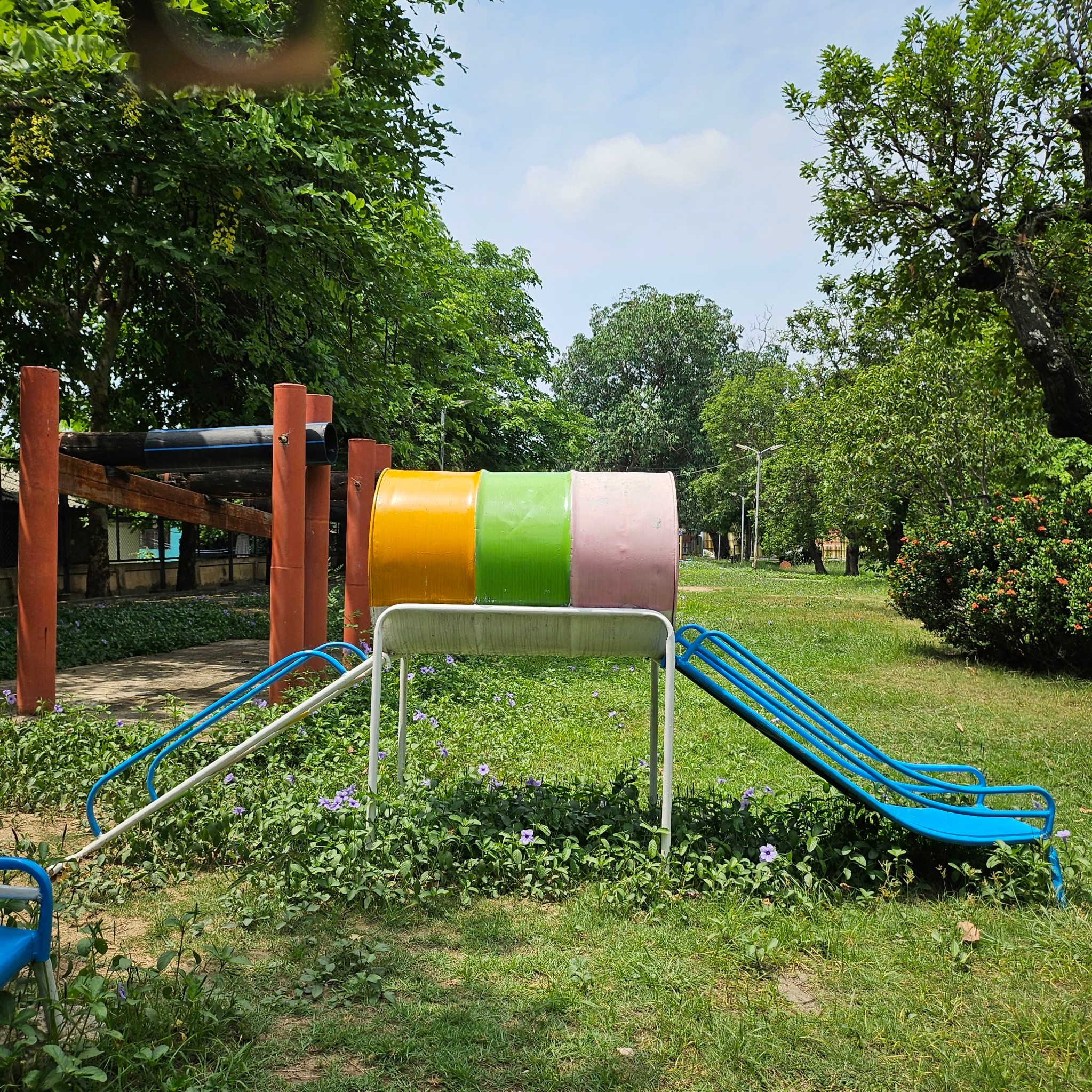
งานวิจัยนี้มีวัตถุประสงค์ในการวิเคราะห์รูปแบบทางกายภาพของพื้นที่เล่นสาธารณะสำหรับเด็ก และอภิปรายถึงปัญหาและโอกาสในการพัฒนา เพื่อเกิดสวนที่เอื้อต่อการเรียนรู้ของเด็กในวัย 3-12 ปี รวมถึงการเชื่อมต่อกิจกรรมการเล่นกับธรรมชาติโดยรอบ เครื่องมือที่ใช้ในการวิจัย คือ แบบสำรวจรูปแบบพื้นที่เล่น และวิเคราะห์ข้อมูลที่ได้ร่วมกับหลักเกณฑ์จากการทบทวนวรรณกรรมเกี่ยวกับการใช้พื้นที่ร่วมกัน ผลการสำรวจ พบว่า ในเขตเทศบาลนครเชียงใหม่ มีการจัดโซนเครื่องเล่นสำหรับเด็ก ในสวนสาธารณะและสนามกีฬา ไว้ 8 แห่ง จากจำนวนสวนทั้งหมด 16 แห่ง โดยพื้นที่สวนนั้นมีลักษณะเด่น คือ ร่มรื่นด้วยต้นไม้ใหญ่ และมีองค์ประกอบทางธรรมชาติที่หลากหลาย เช่น หนองน้ำ เนินดิน ลานทราย ไม้พุ่ม และไม้ดอก เครื่องเล่นส่วนใหญ่ทำด้วยวัสดุพลาสติกขึ้นรูปสีสันสดใสและเหล็ก ที่มีข้อดีในด้านความปลอดภัยและดูแลรักษาได้ง่าย จากการวิเคราะห์ข้อมูลกายภาพและเปรียบเทียบพื้นที่เล่นสาธารณะสำหรับเด็ก ทั้ง 8 แห่ง สวนสาธารณะหนองบวกหาดและสวนสุขภาพบ้านเด่น มีคุณภาพสูงที่สุดในมิติของสภาพแวดล้อมที่เอื้อต่อการเล่นของเด็ก และมีการเชื่อมโยงพื้นที่เล่นกับองค์ประกอบธรรมชาติ อย่างไรก็ตาม ควรเพิ่มความหลากหลายของเครื่องเล่น เพื่อช่วยกระตุ้นการเรียนรู้และส่งเสริมพัฒนาการรอบด้านของเด็ก
Article Details

อนุญาตภายใต้เงื่อนไข Creative Commons Attribution-NonCommercial-NoDerivatives 4.0 International License.
เอกสารอ้างอิง
Aerts, Jens. (2018). Shaping urbanization for children: a handbook on child-responsive urban planning. Retrieved March 31, 2024, from https://www.unicef.org/media /47616/file/UNICEF_Shaping_urbanization_for_children_handbook_2018.pdf.
Ashley, P. (2011). Young children and nature: outdoor play and development, experiences fostering environmental consciousness, and the implications on playground design (Master’s thesis). United States: Virginia Polytechnic Institute and State University.
Bartlett, S., et al (1990). Cities for children: children’s rights, poverty and urban manage- ment. London: Earthscan Publications.
Casey, T. (2007). Environments for outdoor play: a practical guide to make space for children. London: Paul Chapman Publishing.
Cosco, N. & Moore, R.C. (2009). Sensory integration and contact with nature: designing outdoor inclusive environments. The NAMTA journal, 34(2), 168-174.
Chiang Mai Provincial Statistical Office. (2022). Chiang Mai provincial statistical report: 2022. Retrieved June 17, 2024, from https://chiangmai.nso.go.th/images/s-101.pdf.
Digital Government Development Agency. (2021). Bangkok’s population statistic. Retrieved June 5, 2024, from https://data.go.th/dataset/bmastats
Gill, T. (2021). Urban playground: how child-friendly city design can save cities. London: RIBA Publishing.
Hart, R. A. (2016). Children’s participation. New York: Routledge.
Karsten, L. (2010). The status of children in local government spatial planning. Early childhood matters, (114), 33-36.
Koschasan, T. (2014). Kan yai thin khao lae kan prap tua khong phu sung ayu nai khet thetsaban nakhon Chiang Mai. (In Thai) [In-migration and adjustment of the elderly in Chiang Mai Municipality] (Master’s thesis). Chiang Mai: Graduated school of Chiang Mai University.
Nunma, P. (2014). Kan okbaep phuenthi rianru thammachat samrap rongrian pathom- mawai. (In Thai) [The design of natural learning setting for an early childhood school] (Master’s Thesis). Pathumthani: Thammasat University.
Nunma, P. & Kanki, K. (2021). Playing under the flyover in Bangkok from the children’s point of view. Journal of Asian Architecture and Building Engineering, 21(3), 865-883.
Nunma, P. & Kanki, K. (2022). Children’s spaces and creative adaptation in a high-density neighbourhood of the Bangkok metropolitan region: a case study of the Duang Khae neighbourhood. Journal of Asian Architecture and Building Engineering, 22(4), 1–5.
Nunma, P. & Kanki, K. (2023). The roles of the Foundation of Child Development and murals in empowering children and community in Bangkok. Children, Youth and Environments, 33(3), 184–194.
Moore, R.C. (1986). Childhood’s domain: play and place in child development. New York: Croom Helm.
Sampenong, P. & Hemchayart, W. (2018). Kan wikhro rupbaep khong sanam dek len nai suan satharana lak khong Krungthepmahanakhon (In Thai) [An analysis of playground models in Bangkok’s main public parks]. Online Journal of Education, 13(1), 221–233.
Somsuk, P. (1994). Kan wikhro thamle thitang ngong phuen thi long phuea kan phakphon yonchai nai khet thetsaban nakhon Chiang Mai. (In Thai) [Locational analysis of an open space for recreation in Chiang Mai Municipal area] (Master’s Thesis). Chiang Mai: Chiang Mai University.
United Nations. (1989). Convention on the rights of the children. Retrieved June 17, 2024, from https://www.ohchr.org/en/instrumentsmechanisms/instruments/convention-rights-child
Veitch, J., Salmon, J. & Ball, K. (2008). Children’s active free play in local neighborhoods: a behavioral mapping study. Health Education Research, 23(5), 870–879.
Yasai, U., & Tangkittipaporn, J. (2014). Naeothang kan phatthana phuenthi sikhiao yang yang yuen nai khet thetsaban nakhon Chiang Mai. (In Thai) [Sustainable development of green space in Chiang Mai Municipality]. Journal of Community Development and Quality of Life, 2(3), 233–243.
