
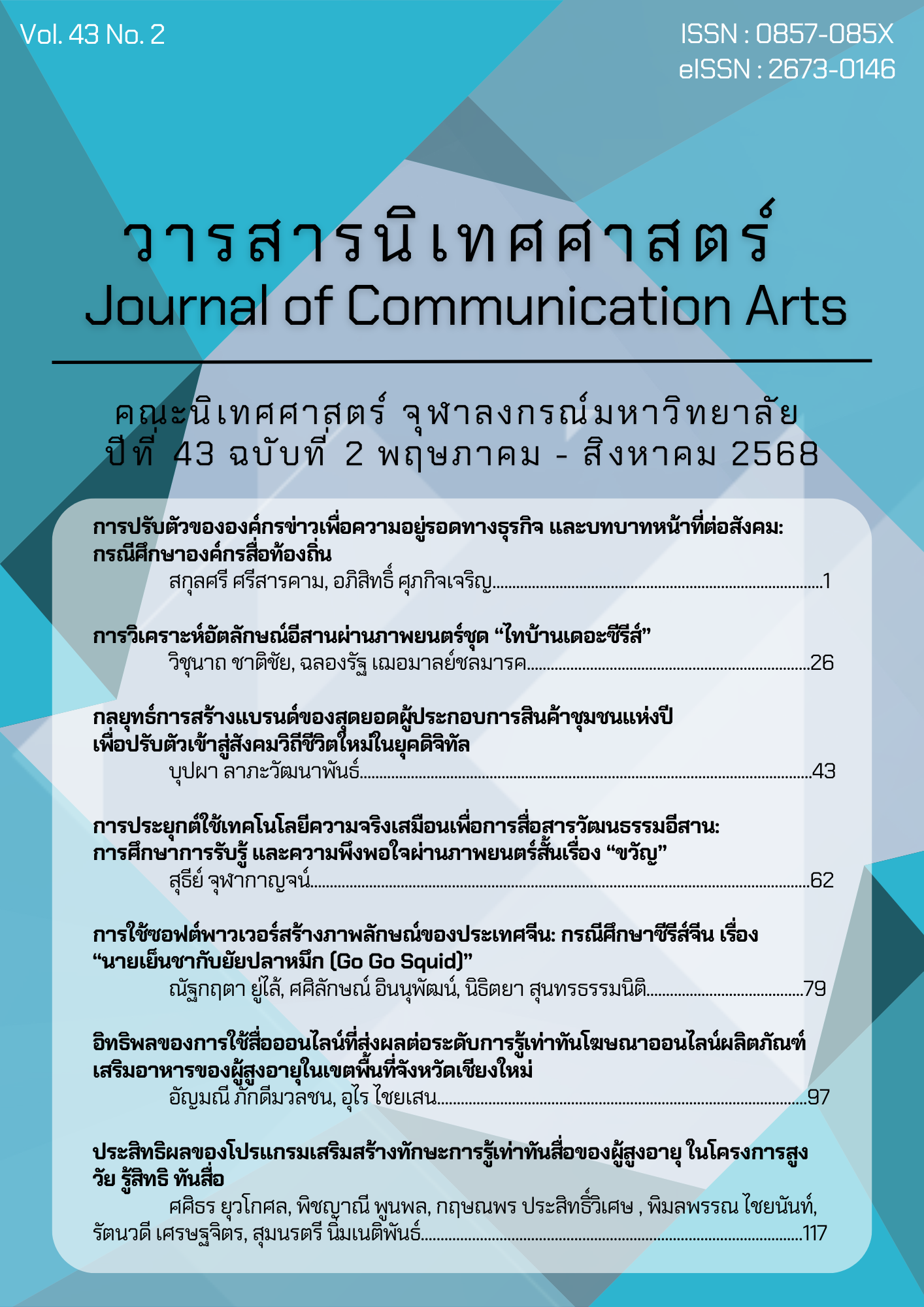
Effectiveness of the Media Literacy Enhancement Program for Older Adults in the Elderly Rights and Media Literacy Project
Article Sidebar
Main Article Content
Abstract
This research aimed to 1) develop a media literacy enhancement program for the elderly as part of the Elderly Rights and Media Literacy Project and 2) examine the effectiveness of the program. The target group consisted of 217 elderly participants from four regions of Thailand: Mukdahan, Chumphon, Chiang Rai and Suphan Buri. The research was conducted in three phases: Phase 1 involved analyzing the media usage problems and their impacts on the elderly based on the experiences and opinions of relevant stakeholders through interviews and focus group discussions. Phase 2 focused on designing and developing the training program. Phase 3 was dedicated to evaluating the program's effectiveness. The findings revealed that the media literacy enhancement program for the elderly, as part of the Elderly Rights and Media Literacy Project, consisted of five modules, along with video content and radio spots. After implementing the program, the elderly participants demonstrated significantly higher media literacy skills post-training compared to their pre-training levels, with statistical significance at the .05 level. The program was designed based on needs of the elderly and utilized an experiential learning approach, focusing on hands-on practice and reflection from experience, which effectively enhanced their media literacy skills.
Article Details

This work is licensed under a Creative Commons Attribution-NonCommercial-NoDerivatives 4.0 International License.
References
กรมกิจการผู้สูงอายุ. (2564). สังคมผู้สูงอายุในปัจจุบันและเศรษฐกิจในประเทศไทย. https://www.dop.go.th/th/know/15/926
มนชนก เซ่งเอียง จันทณี แซ่เอี้ยว ภสกร มีบุญ ลันธิญา เปาะอาเดะ และนิจกานต์ หนูอุไร (2564). พฤติกรรมการใช้ประโยชน์และความพึงพอใจจากแอปพลิเคชันไลน์ที่ส่งผลต่อการรู้เท่าทันสื่อของผู้สูงอายุในเขตอำเภอเมือง จังหวัดสงขลา. วารสารมนุษยศาสตร์และสังคมศาสตร์ มหาวิทยาลัยราชภัฏสงขลา. 3(1), 145-176.
รติยา อัศวติณณา และพิชญาณี พูนพล. (2566). ผลของโปรแกรมพัฒนาการรู้เท่าทันสื่อด้วยกระบวนการเรียนรู้เชิงประสบการณ์ที่ส่งผลต่อพฤติกรรมการใช้สื่อดิจิทัลด้วยปัญญาของผู้สูงอายุในเขตกรุงเทพมหานคร. Journal of Roi Kaensarn Academi, 8(11), 586-598.
วิโรจน์ สุทธิสีมา พิมลพรรณ ไชยนันท์ และศศิธร ยุวโกศล (2563). สถานภาพความรู้การวิจัยเกี่ยวกับการรู้เท่าทันสื่อในประเทศไทยระหว่างปี พ.ศ. 2540-2560. วารสารวิทยาการจัดการ มหาวิทยาลัยราชภัฎเชียงราย. 15(2), 209-238.
สำนักงานคณะกรรมการกิจการกระจายเสียง กิจการโทรทัศน์ และกิจการโทรคมนาคมแห่งชาติ. (2562). รู้สื่อ รู้สิทธิ สานพลังผู้บริโภค. สำนักคุ้มครองผู้บริโภคในกิจการกระจายเสียงและโทรทัศน์.
Bae, S. M. (2022). The mediating effect of digital literacy on the relationship between smartphone use motives and life satisfaction for senior citizens in Korea. Iran Journal of Public Health, 51(2), 336-344.
Knowles, M. S. (1978). The Adult Learning: A Neglected Species. (2 nd edition) Houston: Gulf Publishing. Prentice-Hall.
Kolb, D. (1984). Experiential Learning: Experience As The Source Of Learning And Development. 1(1).
Moore, R. C., & Hancock, J. T. (2022). A digital media literacy intervention for older adults improves resilience to fake news. Scientific Reports, 12, Article 6008. https://doi.org/10.1038/s41598-022-08437-0
Vaportzis, E., Clausen, M. G., & Gow, A. J. (2018) Older adults experiences of learning to use tablet computers: A mixed methods study. Front Psychol. 3(9).
