
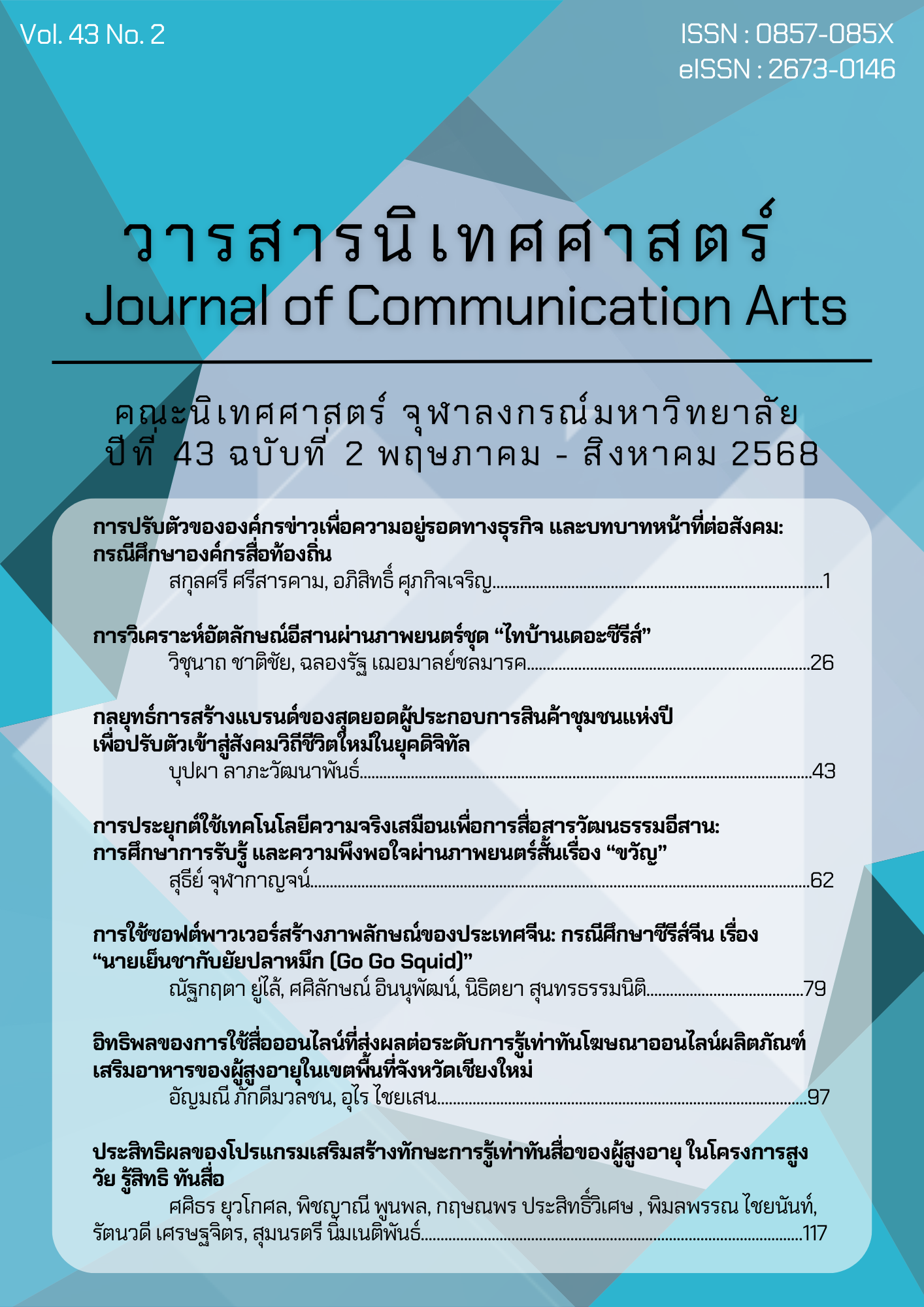
Influence of the Use of Online Media on the Level of Knowledge of Online Advertisements for Dietary Supplements Among the Elderly in Chiang Mai Province
Article Sidebar
Main Article Content
Abstract
The objectives of this study are: 1) to explore the dietary supplement consumption behavior of older adults influenced by online advertising. 2) To measure the level of online advertising literacy regarding dietary supplements among older adults, and 3) To explain the influence of online media usage, dietary supplement consumption behavior influenced by online advertising, and the level of knowledge about online advertising content on the level of online advertising literacy regarding dietary supplements among older adults. This study employed a quantitative research design using a survey method with a questionnaire to collect data from 400 older adults in Chiang Mai Province. The sample was selected through multi-stage sampling. The research findings revealed that older adults aged 60–65 years accounted for 56.80%. Most had completed lower secondary education or below (36.50%), with the majority being housewives/househusbands (30.30%). More than half had an income of less than 10,000 baht (53.80%). 1) The dietary supplement consumption behavior of older adults through online advertising was at a moderate level ( = 2.65, S.D. = 1.10). 2) The level of online advertising literacy regarding dietary supplements among older adults was at a moderate level ( = 3.21, S.D. = 0.85). 3) Six predictor variables influenced the level of online advertising literacy among older adults: dietary supplement consumption level (R² = 0.092, 9.20%); frequency of purchasing dietary supplements through online advertising (R² = 0.231, 23.10%); duration of dietary supplement consumption (R² = 0.304, 30.40%); expenditure on dietary supplements (R² = 0.336, 33.60%); level of knowledge about online advertising content (R² = 0.359, 35.90%); and number of hours spent using online media (R² = 0.376, 37.60%).he objectives of this study are: 1) to explore the dietary supplement consumption behavior of older adults influenced by online advertising. 2) To measure the level of online advertising literacy regarding dietary supplements among older adults, and 3) To explain the influence of online media usage, dietary supplement consumption behavior influenced by online advertising, and the level of knowledge about online advertising content on the level of online advertising literacy regarding dietary supplements among older adults. This study employed a quantitative research design using a survey method with a questionnaire to collect data from 400 older adults in Chiang Mai Province. The sample was selected through multi-stage sampling. The research findings revealed that older adults aged 60–65 years accounted for 56.80%. Most had completed lower secondary education or below (36.50%), with the majority being housewives/househusbands (30.30%). More than half had an income of less than 10,000 baht (53.80%). 1) The dietary supplement consumption behavior of older adults through online advertising was at a moderate level ( = 2.65, S.D. = 1.10). 2) The level of online advertising literacy regarding dietary supplements among older adults was at a moderate level ( = 3.21, S.D. = 0.85). 3) Six predictor variables influenced the level of online advertising literacy among older adults: dietary supplement consumption level (R² = 0.092, 9.20%); frequency of purchasing dietary supplements through online advertising (R² = 0.231, 23.10%); duration of dietary supplement consumption (R² = 0.304, 30.40%); expenditure on dietary supplements (R² = 0.336, 33.60%); level of knowledge about online advertising content (R² = 0.359, 35.90%); and number of hours spent using online media (R² = 0.376, 37.60%).
Article Details

This work is licensed under a Creative Commons Attribution-NonCommercial-NoDerivatives 4.0 International License.
References
กรมกิจการผู้สูงอายุ. (2566). รายงานสถานการณ์ผู้สูงอายุไทย พ.ศ. 2566. กระทรวงการพัฒนาสังคมและความมั่นคงของมนุษย์. http://www.dop.go.th
กาญจนา ปัญญาธร และเสาวลักษณ์ ทาแจ้ง. (2563). ทัศนคติต่อผลิตภัณฑ์และการบริโภคผลิตภัณฑ์อาหารเสริมของผู้สูงอายุบ้านหนองนุ ต.พร้าว อ.เมือง จ.อุดรธานี, วารสารการแพทย์โรงพยาบาลอุดรธานี, 28(2), 121-129.
กาญจนา ปัญญาธร รวีวรรณ เผ่ากันหา และนันท์นลิน แก้วคำหอม. (2565). ความสัมพันธ์ระหว่างปัจจัยพื้นฐาน การรับรู้ประโยชน์ การรู้เท่าทันสื่อ ทัศนคติและพฤติกรรมการใช้สื่อออนไลน์บนโทรศัพท์มือถือของผู้สูงอายุ. วารสารการแพทย์โรงพยาบาลอุดรธานี, 33(1), 99-113.
เกวรินทร์ ละเอียดดีนันท์. (2557). การยอมรับเทคโนโลยีและพฤติกรรมผู้บริโภคออนไลน์ที่มีผลต่อการตัดสินใจซื้อหนังสืออิเล็กทรอนิกส์ของผู้บริโภคในเขตกรุงเทพมหานคร. บริหารธุรกิจมหาบัณฑิต มหาวิทยาลัยกรุงเทพ.
จารุวรรณ นิธิไพบูลย์. (2564). การพัฒนาศักยภาพการใช้สื่อสังคมออนไลน์และแอปพลิเคชั่นของผู้สูงอายุ. วารสารนิเทศศาสตรปริทัศน์, 25(2), 77-89.
จินตนา ตันสุวรรณนนท์. (2557) ความสัมพันธ์ระหว่างการรู้เท่าทันสื่อโฆษณากับพฤติกรรมบริโภคนิยมของเยาวชนในเขตกรุงเทพมหานคร. มหาวิทยาลัยราชภัฏสวนดุสิต: กรุงเทพฯ.
ฐานันดร สหะวรกุลศักดิ์. (2561). ศักยภาพการรู้เท่าทันสื่อที่ส่งผลต่อการตระหนักรู้โฆษณาหลอกลวงในกลุ่มผลิตภัณฑ์เสริมอาหารในจังหวัดชลบุรี. วิทยานิพนธ์ บริหารธุรกิจมหาบัณฑิต, มหาวิทยาลัยบูรพา.
ฐานันดร สหะวรกุลศักดิ์ และสมบัติ ธำรงสินถาวร. (2561). ศักยภาพการรู้เท่าทันสื่อที่ส่งผลต่อการตระหนักรู้โฆษณาหลอกลวงในกลุ่มผลิตภัณฑ์เสริมอาหาร ในจังหวัดชลบุรี. วารสารบัณฑิตศึกษา มหาวิทยาลัยราชภัฏสวนสุนันทา,11(2), 26-37.
เทพไทย โชติชัย เสาวลักษณ์ ศรีดาเกษ อาทิตย์ ฉัตรชัยพลรัตน์ และอิสรีย์ ปัดภัย. (2564). ปัจจัยที่มีความสัมพันธ์กับพฤติกรรมการใช้ผลิตภัณฑ์อาหารเสริมเพื่อสุขภาพของผู้สูงอายุ. วารสารวิทยาลัยพยาบาลราชชนนี อุตรดิตถ์, 13(2), 87-101.
ผุสดี เวชชพิพัฒน์ กรัณฑรัตน์ บุญช่วยธนาสิทธิ์ ภัคพธู อุ่นงามพันธุ์ สุภาภรณ์ ปั้นพล และจินตนา เทียมทิพร, 2562. รายงานการสำรวจความรู้และพฤติกรรมการบริโภคผลิตภัณฑ์สุขภาพของ ประชาชน ในชุมชนกลุ่มเป้าหมายของโครงการ ฯ ที่ 25 จังหวัดดำเนินการภายใต้โครงการ เครือข่ายชุมชนร่วมใจ ป้องกันภัยผลิตภัณฑ์สุขภาพ ปีงบประมาณ พ.ศ. 2562. กองพัฒนาศักยภาพผู้บริโภคสำนักงานคณะกรรมการอาหารและยา กระทรวงสาธารณสุข, (เอกสารอัดสำเนา).
บุบผา เมฆสีทองคำ. (2554). การศึกษาการรู้เท่าทันสื่อ : วิถีทางในการสร้างพลังการรู้เท่าทันสื่อ. วารสารนักบริหาร, 31(2), 63-69.
ปพิชญา เรืองฤทธิ์. (2565). สื่อโฆษณาผลิตภัณฑ์อาหารเสริมสมุนไพรกับการตัดสินใจซื้อของผู้สูงอายุ. ปริญญาการจัดการมหาบัณฑิต : มหาวิทยาลัยมหิดล.
พระราชบัญญัติอาหาร พ.ศ. 2522. (2522). ราชกิจจานุเบกษา. เล่ม 96 ตอนที่ 102 ก.
พระราชบัญญัติคุ้มครองผู้บริโภค (ฉบับที่ 4) พ.ศ. 2562. (2562). ราชกิจจานุเบกษา. เล่ม 136 ตอนที่ 61 ก.
มติชนออนไลน์. (2563). อย.ฟันโฆษณาผลิตภัณฑ์สุขภาพกว่า 500 คดี ปี’62 ระงับเผยแพร่ 2.5 แสนรายการ. https://www.matichon.co.th/local/news_1978046
ศริพัฒน์ ยอดเพชร. (2560). โรงเรียนผู้สูงอายุ: ชุดความรู้ การพัฒนาเป็นผู้สูงอายุที่มีศักยภาพ. กรุงเทพฯ: มูลนิธิสถาบันวิจัยและพัฒนาผู้สูงอายุไทย.
สำนักงานคณะกรรมการอาหารและยา. (2564). คู่มือการใช้ผลิตภัณฑ์เสริมอาหารอย่างปลอดภัย. กระทรวงสาธารณสุข.
สำนักงานคณะกรรมการคุ้มครองผู้บริโภค. (2565). รายงานสถานการณ์การโฆษณาเกินจริงในสื่อออนไลน์. กรุงเทพฯ: สคบ. https://www.thairath.co.th/news/politic/2620755
อาภัสรา บัวประดิษฐ์ และสุรศักดิ์ เสาแก้ว. (2562). ผลของโปรแกรมพัฒนาการรู้เท่าทันสื่อโฆษณาต่อพฤติกรรมการเลือกบริโภคผลิตภัณฑ์สุขภาพในกลุ่มผู้สูงอายุที่ใช้แอปพลิเคชันไลน์ในจังหวัดนครนายก. วารสารเภสัชกรรมไทย, 12(4), 932-942.
Aditya. (2001). The psychology of deception in marketing: A conceptual framework for research and practice. Psychology and Marketing. 18(7), 735 – 761.
A. Gonzalez, M. Paz Ramirez & V. Viadel. (2012). Attitudes of the Elderly toward Information and Communications Technologies. Educational Gerontology. 38(9), 585-594.
Anderson, L. W., & Krathwohl, D. R. (Eds.). (2001). A taxonomy for learning, teaching, and assessing: A revision of Bloom’s taxonomy of educational objectives. Longman.
Axon, D. R., Vanova, J., Edel, C., & Slack, M. (2017). Dietary supplement use, knowledge, and perceptions among student pharmacists. American Journal of Pharmaceutical Education. 81(5), 92.
Barnes, L. A. J., Barclay, L., McCaffery, K., Aslani, P. (2019b). Women’s health literacy and the complex decision-making process to use complementary medicine products in pregnancy and lactation. Health Expectations. 22, 1013-1027.
Bloom, B. S. (Ed.). (1956). Taxonomy of educational objectives: The classification of educational goals. Handbook I: Cognitive domain. David McKay.
Hair, J. F., Anderson, R. E., Tatham, R. L., & Black, W. C. (1998). Multivariate data analysis (5th ed.). Prentice Hall.
Katz, E., Blumler, J. G., & Gurevitch, M. (1973-1974). Uses and gratifications research. Public Opinion Quarterly, 37(4), 509–523. https://doi.org/10.1086/268109
Kinyupen.co. (2017). Aging society in the digital age When the elderly become "victims" of supplements. https://shorturl.asia/YsdZB.
Kotler, P. (1999). Marketing Management: Analysis, Planning, Implementation and Control. 9th Edition, Prentice : Hall College Inc.
Krysik, J.L. and Finn, J. (2010). Research for effective social work practice. McGraw Hill : New York.
Livingstone, S., & Helsper, E. J. (2006). Does advertising literacy mediate the effects of advertising on children? A critical examination of two linked research literatures in relation to obesity and food choice. Journal of Communication, 56(3), 560–584. https://doi.org/10.1111/j.1460-2466.2006.00301
Mcleod & O’Keefe. (1972). Socialization Perspective; Current Perspectives in Mass Communication Research. Sage Publication.
Maliheh, S., Shima, S. & Robob, S. (2015). Application of the Internet and its Association With Loneliness Among Retired Teachers. Iranian Journal of Ageing. 9(1), 63-72.
Peral-Peral, B., Arenas-Gaitán, J., & Villarejo-Ramos, Á.-F. (2015). From digital divide to psycho-digital divide: Elders and online socil networks. Comunicar (Media Education Research Journal), 23(45), 57–64. https://doi.org/10.3916/C45-2015-06
Radwan, H., Hasan, H. A., Ghanem, L., Alnajjar, G., Shabir, A., Alshamsi, A., Alketbi, F. (2019). Prevalence of dietary supplement use and associated factors among college students in the United Arab Emirates. Journal of Community Health. 44, 1135-1140.
Research and Development Branding Marketing for Food Supplements & Beverage. (2566). Dietary supplement industry trends. https://medikalabs.com/ (in Thai)
Rozendaal, E., Lapierre, M. A., van Reijmersdal, E. A., & Buijzen, M. (2011). Reconsidering advertising literacy as a defense against advertising effects. Media Psychology. 14, 333-354. https://doi.org/10.1080/15213269.2011.620540
Tan, Edwin C.K., Eshetie T.C., Gray, S.L., Marcum, Z.A. (2022). Dietary Supplement Use in Middle-aged and Older Adults. The Journal of nutrition health and aging, 26(2), 133-138.
Taro Yamane. (1973). Statistics: an introductory analysis. Harper & Row : New York.
Vosner, H.B., Bobek, S., Kokol, P., &Krecic, M.J. (2015). Attitudes of active older Internet users towards online social networking. Computers in Human Behavior. 55, 230-241.
Wathe, J. (2020). The problem of advertising the sale of dietary supplements online. http://www.lawgrad.ru.ac.th/Abstracts/714.
Yates, B.L. (2001). Media literacy and attitude change: Assessing the effectiveness of media literacy training on children’s responses to persuasive messages within the ELM.
Yang, S. C., Hsu, W., & Chiang, C. (2020). The associations among individual factors, media literacy and dietary supplement use among college students: Cross-sectional study. Journal of Medical Internet Research. 22(8), e19056
