Arts Creative Research of Reflective Concept, Khon Mask: Role and Duty
Article Sidebar
Main Article Content
Abstract
The research project titled “Reflective Concept, “Khon Masks: Roles and Duties” is creative research in the field of fine arts. The objectives are 1) to study the relationship of characters in Ramakien, patterns of Khon masks including role and duty of people in society, 2) to synthesize information and interpret from figurative language to create contemporary Khon masks, and 3) to convey the ideas through an art exhibition.
The research employs qualitative methods through the following research tools: 1) record forms for six characters from the Ramakien epic that have governance-related relationships, and 2) Interview forms for three administrative staff members from Poh-Chang Academy of Arts. Because the roles and duties are metaphorically related to the expressions "wearing the Khon mask" and "taking off the Khon mask," the research findings are as follows:
1) The study found governance-related relationships among the characters in the Ramakien. These relationships include governance by division (avatars), governance by lineage, and governance by succession. Interviews with administrative staff revealed that they all metaphorically "wearing the Khon mask" to perform various roles and functions, sometimes simultaneously embodying multiple avatars. Key phrases from the interviews include "mask layering," "wearing the Khon mask," and "transforming faces."
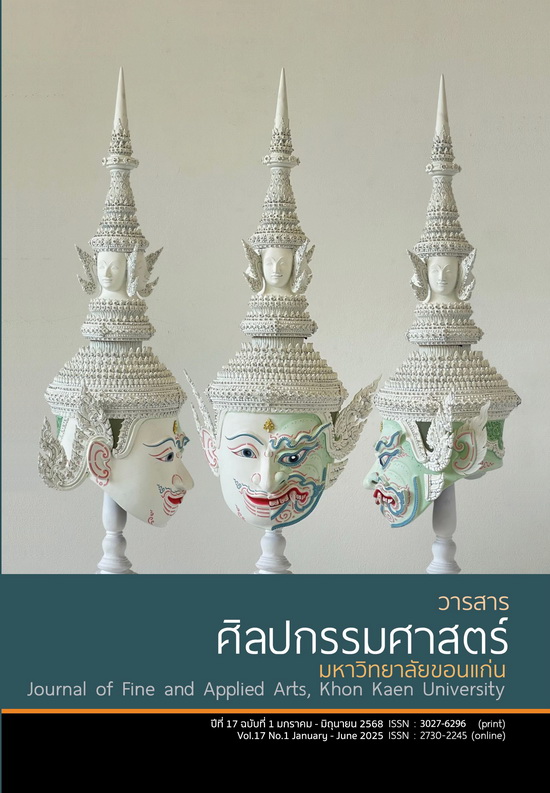
2) The creative outputs consist of three contemporary Khon masks that represent the three forms of governance relationships. These include the human mask with a layered face, the monkey mask covered by the shape of Khon mask, and the ogre mask displaying a half-finished state of transformation. The designs and creation methods focus on primary visual elements, such as color and form, layered to reflect the relationships between characters in the Ramakien literature.
3) The works were presented in the "Live Life Learn" exhibition at the Ratchadamnoen Contemporary Art Center. The exhibition used symbolic comparisons to link the meanings of the Khon masks and metaphors with roles and duties, aiming to stimulate viewers' imaginations. This approach influenced viewers' emotional perception and interpretation of the artworks, fostering positive attitudes and intellectual empowerment by encouraging aesthetic emotional responses.
Article Details

This work is licensed under a Creative Commons Attribution-NonCommercial-NoDerivatives 4.0 International License.
Content and information in articles published in the Journal of Fine and Applied Arts of Khon Kaen University is regarded as the opinion and sole responsibility of the author(s) directly; therefore, editors are not obliged to agree to or share any responsibility with regard to the content and information that appears within these articles.
All articles, information, content, image, etc. that have been published in the Journal of Fine and Applied Arts of Khon Kaen University is the copyright of the Journal of Fine and Appllied Arts of Khon Kaen University. Any person or organization who wishes to distribute all or parts of the articles for further dissemination or other usage must first receive permission from the Journal of Fine and Applied Arts of Khon Kaen University before proceeding to do so.
References
นฤทธิ์ วัฒนฦู. (2561). หัวโขน สัญลักษณ์แห่งรามเกียรติ์. กรุงเทพฯ : วาดศิลป์.
พิสิทธิ์ ศรีประเสริฐ. (2561). อาหารไทย: การนำเสนออัตลักษณ์อุดมการณ์ความเป็นไทยและวาทกรรมเชิงอำนาจ. วารสารการสื่อสารมวลชน มหาวิทยาลัยเชียงใหม่, 6(1), 1-35.
ราชบัณฑิตยสถาน. (2546). พจนานุกรมฉบับราชบัณฑิตยสถาน พ.ศ. 2542. กรุงเทพฯ: นานมีบุ๊คส์พับบลิเคชั่น.
สิริวรรณพิชา ธนจิราวัฒน์. (2558). การศึกษาเปรียบเทียบภาพสะท้อนทางวัฒนธรรม ผ่านสำนวนไทย จีน และอังกฤษ. กรุงเทพฯ : มหาวิทยาลัยเทคโนโลยีราชมงคลรัตนโกสินทร์.
สุจิตต์ วงษ์เทศ. (2532). ร้องรำทำเพลง : ดนตรีและนาฏศิลป์ชาวสยาม. กรุงเทพฯ : มติชน.
สุดวดี สุวรรณ. (2565). สุรศักดิ์ เจริญวงศ์ ในสัญญาวิจักษ์ : สุนทรียะจากสำนึกแห่งสายใย. วิทยานิพนธ์ปริญญาปรัชญาดุษฎีบัณฑิต สาขาทัศนศิลป์และการออกแบบ คณะศิลปกรรมศาสตร์ มหาวิทยาลัยบูรพา.
เสาวณิต จุลวงศ์. (2536). โครงสร้างของสังคมในรามเกียรติ์ ฉบับพระราชนิพนธ์ในรัชกาลที่ 1. กรุงเทพฯ : มหาวิทยาลัยศิลปากร.
