
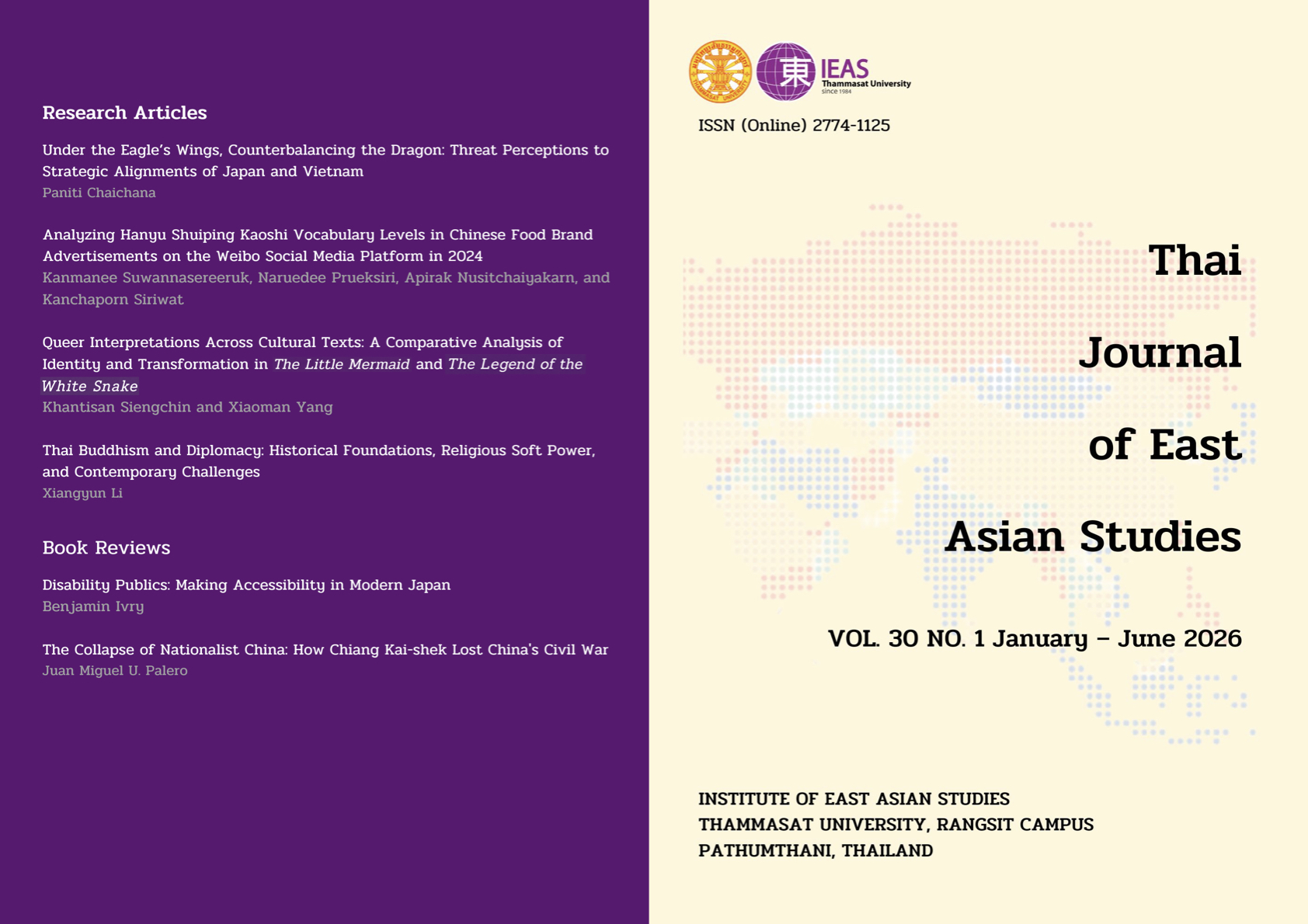
Analyzing Hanyu Shuiping Kaoshi Vocabulary Levels in Chinese Food Brand Advertisements on the Weibo Social Media Platform in 2024
Keywords:
HSK, advertisements, Chinese food brands, WeiboAbstract
This quantitative research with qualitative interpretation analyzes 1) the distribution of Chinese vocabulary in Hanyu Shuiping Kaoshi (HSK) levels in leading Chinese food brand advertisements on the Weibo platform in 2024; 2) frequency of vocabulary usage in levels 1 to 9; and 3) vocabulary item characteristically absent from HSK vocabulary lists in advertising language. Data is collected from ten major Chinese food company advertisements with 18,156 words, including 3,355 unique words. Comparison to HSK Levels 1 to 9 vocabulary lists shows that the vocabulary covers all levels, with items not in the HSK lists comprising the largest proportion (46.29%). These non-HSK items are placed in three key categories: food and brand-specific; marketing and promotional; and internet-based atmospheric. Next, high-level vocabulary (HSK 7 to 9) is at 11.92%, with elementary to intermediate levels (HSK 1 to 6) at 4.77% to 8.88% of the total. In terms of frequency, basic words such as “的”, “一”, “吃”, “来”, and “你” appeared oftenest, reflecting structural simplicity and strategic semiotic use. These findings suggest a gap between textbook language and commercial language use, which may help to develop foundational business Chinese vocabulary and promote digital literacy through informal language learning in society today.
Downloads
References
กฤตติกา เศวตอมรกุล. (2564, 7 พฤศจิกายน). ภาษาจีน ภาษาที่น่าสนใจแห่งยุคสมัย. สมาคมผู้สื่อข่าวไทย-จีน. https://www.tcjapress.com/2021/11/07/chinese-language-as-a-world-language/
ภาวุธ พงษ์วิทยภานุ. (2568, 30 มกราคม). พาสำรวจ…ธุรกิจร้านอาหารจีน ขยายตัวสู่อาเซียนอย่างไร. ประชาชาติธุรกิจ. https://www.prachachat.net/opinion-column-8/news-1743295
วรรณา เหล่าเขตกิจ, อนงครัตน์ บังศรี, ไพลิน สุโพธิ์แสน, ทิฆัมพร พันธัง, และ สุชาดา หาญสุวรรณ. (2567). การวิเคราะห์คำศัพท์ HSK ในเพลงของวง WayV (威神 V). วารสารมนุษยศาสตร์และสังคมศาสตร์ มหาวิทยาลัยราชภัฏอุดรธานี, 13(2), 23–36.
วิสุดา แก้วหยด. (2563). การวิเคราะห์คำศัพท์ HSK ในหนังสือเรียนภาษาจีนของนักศึกษาสาขาวิชาภาษาจีน คณะมนุษยศาสตร์และสังคมศาสตร์ มหาวิทยาลัยราชภัฏอุบลราชธานี. วารสารมนุษยศาสตร์และสังคมศาสตร์ มหาวิทยาลัยราชภัฏอุบลราชธานี, 11(2), 134–150.
อภิรักษ์ นุสิทธิ์ชัยการ, ปัญญาพร ไพรสิงห์, และ กัญชพร ศิริวาท. (2568). การศึกษาระดับของคำศัพท์ภาษาจีนในปาฐกถาของสี จิ้นผิง โดยอ้างอิงระดับคำศัพท์ของ HSK เพื่อประยุกต์ใช้ในการเรียนการสอนภาษาจีน. ใน สัญญา สะสอง (บ.ก.), รายงานสืบเนื่องจากการประชุมวิชาการด้านมนุษยศาสตร์และสังคมศาสตร์ระดับชาติ ครั้งที่ 7 และระดับนานาชาติ ครั้งที่ 4 (น. 44–58). คณะมนุษยศาสตร์และสังคมศาสตร์ มหาวิทยาลัยราชภัฏเชียงใหม่.
Flew, T. (2015). Social media governance. Social Media + Society, 1(1), 1–2. https://doi.org/10.1177/2056305115578136
Globish. (2020, September 26). HSK คืออะไร ทำไมอยากไปเรียนต่อต้องสอบ. https://www.globish.co.th/blog/study-abroad/whatis-hsk
Hongcan & CNR. (2024, July 26). “2024年度中国餐饮品类十大品牌” 榜单隆重揭晓! [The “10 leading brands in Chinese catering categories of 2024” list grandly unveiled!]. CNR. https://www.cnr.cn/sazg/cpsc/20240726/t20240726_526816943.shtml
Krashen, S. D. (1982). Principles and practice in second language acquisition. Pergamon Press. https://www.sdkrashen.com/content/books/principles_and_practice.pdf
Ministry of Education of the People’s Republic of China. (2021, March 31). Guójì zhōngwén jiàoyù zhōngwén shuǐpíng děngjí biāozhǔ [The Chinese proficiency grading standards for international Chinese language education]. http://www.moe.gov.cn/jyb_xwfb/gzdt_gzdt/s5987/202103/t20210329_523304.html
Sockett, G. (2014). The online informal learning of English. Palgrave Macmillan.
Song, Q., Ung, C. O. L., Tang, D., & Hu, H. (2019). The use of microblog “Weibo” by Chinese patent medicine companies in China. Therapeutic Innovation and Regulatory Science, 53(4), 490–496. https://doi.org/10.1177/2168479018798799
Sun, X., Woraviboonsawat, S., & Zhang, C. (2020). The importance of the Chinese language in today’s international business. Journal of Suvarnabhumi Institute of Technology (Humanities and Social Sciences), 6(1), 601–610.
Xu, X., Zhao, M., & Wang, M. Y. (2025). Chinese social media I: Insider, intercultural and interdisciplinary perspectives. Routledge.
Downloads
Published
How to Cite
Issue
Section
License
Copyright (c) 2026 Thai Journal of East Asian Studies

This work is licensed under a Creative Commons Attribution-NonCommercial-NoDerivatives 4.0 International License.


