
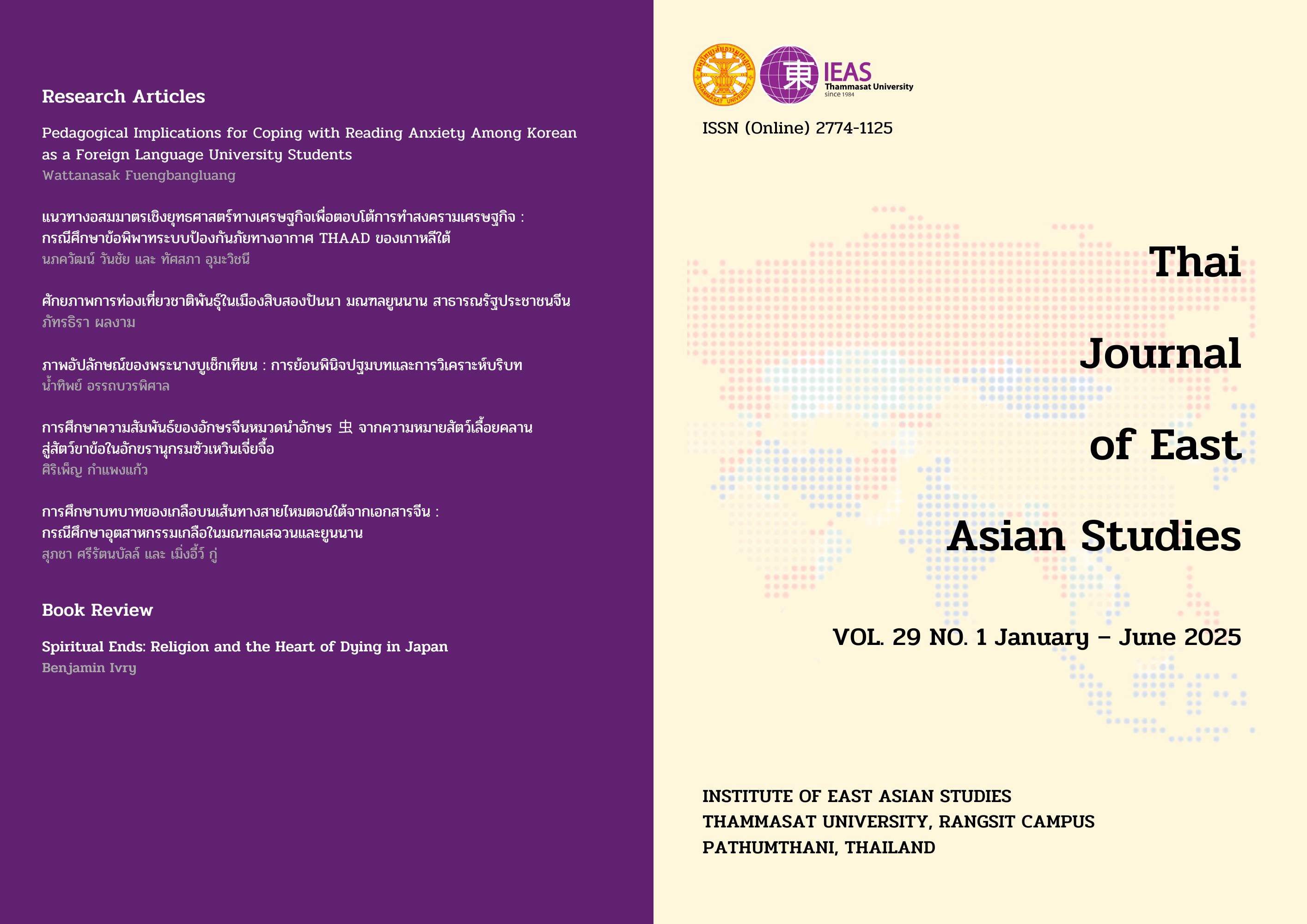
Spiritual Ends: Religion and the Heart of Dying in Japan
คำสำคัญ:
death in Japan, hospice, kokoroบทคัดย่อ
This publication by Assistant Professor Timothy O. Benedict, who teaches in the School of Sociology at Kwansei Gakuin University, Japan, is an ethnographic case study and memoir. It is based on interviews with hospice patients and workers, compiled when the author served as a chaplain at a Presbyterian hospital in western Japan between 2009 and 2011.
These origins give an inescapably Christian outlook to a research work about a country, most of whose inhabitants adhere to Shintoism. Assistant Professor Benedict maintains an empathetic tone in his descriptions of the bafflement expressed by patients confronted with his essentially Christian approach to counseling. He stresses that Japan as a super-aging society where the birthrate is in decline will require caregivers to assist aged persons at the end of their lives. This role may be fulfilled by hospices, which try to preserve a sense of patient individuality and personhood, or kokoro (heart, spirit, mind, wisdom, aspiration, essence, attention, sincerity and sensibility). In addition, hospice chaplains may increasingly serve a population without many affinities to traditional organized religion, as usually defined in theistic societies.
Downloads
เอกสารอ้างอิง
Akira, Ō., & Unno, T. (1992). The Genealogy of Sorrow: Japanese View of Life and Death. The Eastern Buddhist, 25(2), 14–29. http://www.jstor.org/stable/44361962
Benedict, T. (2023). Spiritual Ends: Religion and the Heart of Dying in Japan. University of California Press.
Hearn, L. (1896). Kokoro: Hints and Echoes of Japanese Inner Life. Houghton Mifflin/Riverside Press.
Illueca, M., Bradshaw, Y., & Carr, D. B. (2023). Spiritual Pain: A Symptom in Search of a Clinical Definition. The Journal of Religion and Health, 62(3), 1920–1932. https://doi.org/10.1007/s10943-022-01645-y
Kanayama, A. (2017). The Japanese views of death and life and human remains. Journal of Forensic Research, 8(6), 1–3. https://doi.org/10.4172/2157-7145.1000404
Kim, H. (2023). Everyday rehearsal of death and the dilemmas of dying in super-ageing Japan. Modern Asian Studies, 57(1), 32-52.
Kimura, R. (1996). Death and Dying in Japan. Kennedy Institute of Ethics Journal, 6(4), 374-378. https://dx.doi.org/10.1353/ken.1996.0038
Lipscy, P. Y. (2023). Japan: the harbinger state. Japanese Journal of Political Science, 24(1), 80–97.
Muramatsu, N., & Akiyama, H. (2011). Japan: Super-Aging Society Preparing for the Future. The Gerontologist, 51(4), 425–432.
Nakagawa, Y. (1995). Death with dignity in the Japanese culture. Psychiatry and Clinical Neurosciences, May:49 Suppl 1: S161-3. PMID: 9179962.
Picken, S. D. B. (2017). Shinto and death: From cultural roots to contemporary thought. In C. M. Moreman (Ed.), The Routledge Companion to Death and Dying. Routledge.
Sugiyama, A., Matsuoka, T., Sakamune, K., Akita, T., Makita, R., Kimura, S., Kuroiwa, Y., Nagao, M., & Tanaka, J. (2020). The Tokyo subway sarin attack has long-term effects on survivors: A 10-year study started 5 years after the terrorist incident. PLoS ONE, 15(6). e0234967. https://doi.org/10.1371/journal.pone.0234967
Suzuki, H. (2013). Death and Dying in Contemporary Japan. Routledge.
ดาวน์โหลด
เผยแพร่แล้ว
รูปแบบการอ้างอิง
ฉบับ
ประเภทบทความ
สัญญาอนุญาต
ลิขสิทธิ์ (c) 2025 Thai Journal of East Asian Studies

อนุญาตภายใต้เงื่อนไข Creative Commons Attribution-NonCommercial-NoDerivatives 4.0 International License.


