
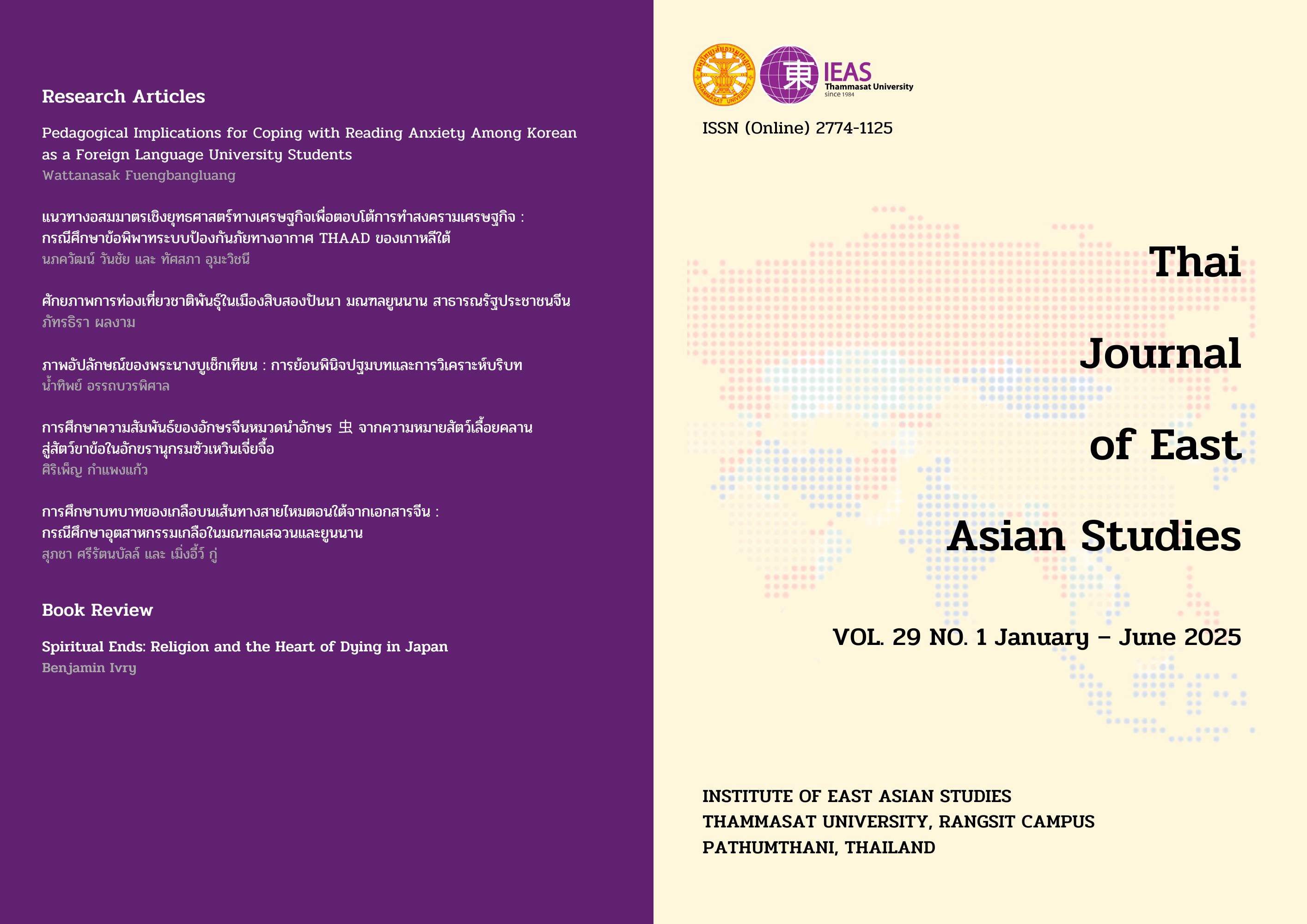
Pedagogical Implications for Coping with Reading Anxiety Among Korean as a Foreign Language University Students
คำสำคัญ:
pedagogical implications, KFL student reading anxiety, reading comprehension, foreign language anxietyบทคัดย่อ
This study analyzed research implications from journal articles to discern pedagogical implications for coping with reading comprehension anxiety among Korean as a foreign language (KFL) university students. In April 2024, 15 articles were chosen from online journal databases in South Korea, including Korean Studies Information Service System (KISS) and Korea Citation Index (KCI). Content analysis was used to analyze articles following the pedagogical implications of emotional control and instructional design. Results were that most discussed was de-stressing the learning context by teaching student reading strategy and redesigning appropriate instructional contents to suit target KFL students, followed by emotional control. Two pedagogical implications were suggested: a) giving appropriate feedback to student responses; and b) sequencing the instructional design based on pre-reading, while reading, and post-reading.
Downloads
เอกสารอ้างอิง
Capan, S. A., & Pektas, R. (2013). An empirical analysis of the relationship between foreign language reading anxiety and reading strategy training. English Language Teaching, 6(12), 181–188.
Da-seum, L. (2020). A Study on Vietnamese Korean language learners’ reading anxiety through interviews. 우리말연구, (61), 143-182.
Fraenkel, J. R., Wallen, N. E., & Hyun, H. H. (2012). How to design and evaluate research in education (8th ed.). Mc Graw HIll.
Gkonou, C., Daubney, M., & Dewaele, J. (2017). New insights into language anxiety: Theory, research and educational implications. Multilingual Matters.
Horwitz, E. (2001). Language anxiety and achievement. Annual review of applied linguistics, 21, 112-126.
Horwitz, E. K., Horwitz, M. B., & Cope, J. (1986). Foreign Language Classroom Anxiety. The Modern Language Journal, 70(2), 125–132. https://doi.org/10.2307/327317
Hyun-jin, P. (2018). Correlation between anxiety factors and level of anxiety in second language reading with focus on intermediate level Korean language learners. The Study of Korean Language and Literature, 60, 361-393.
Hyun-Jin, P. (2020). A study on reading anxiety factors in beginner Korean language learners. The Study of Korean Language and Literature, 66, 337-366.
Hyun-jin, P., & Jeong-eun, K. (2017). Relationships between reading anxiety and advanced Korean learners academic performances: In the context of Korean for academic purposes. Bilingual Research, 67, 129-160.
Jee, M. J. (2012). Effects of language anxiety on three levels of classes of Korean as a foreign language. Journal of Korean Language Education, 23(2), 467-487.
Jee, M. J. (2014). Affective factors in Korean as a foreign language: Anxiety and beliefs. Language, Culture and Curriculum, 27(2), 182-195.
Jee, M. J. (2018). Four skill-based foreign language anxieties: Learners of Korean in Australia. Linguistic Research, 35, 23–45.
Jee, M. J. (2019). Foreign language anxiety and self-efficacy: Intermediate Korean as a foreign language learners. 어학연구, 55(2), 431-456.
Joo, K. Y., & Damron, J. (2015). Foreign language reading anxiety: Korean as a foreign language in the United States. Journal of the National Council of Less Commonly Taught Languages, 17(1), 23-48.
Johnson, B., & Christensen, L. B. (2020). Educational research: Quantitative, qualitative, and mixed approaches (7th ed). SAGE publications.
Lee, H. S. (2012). Using diary studies to examine reading anxiety in KFL learners. Journal of the International Network for Korean Language and Culture, 9(1), 221-245.
Myat. (2019). A study on the anxiety of reading and learning Korean for Myanmar learners. Language Facts and Perspectives, 48, 571-597.
Ning, W. (2023). Anxiety among Korean learners reading modern poetry: Survey of advanced Korean Language learners in China. 국어교육연, (51), 277-321.
Petasen, P., & Mesupnikom, N. (2020). Korean language education (KLE) and Korean studies (KS) in Thailand’s universities: Current status, problems and challenges, and policy recommendations. Thai Journal of East Asian Studies, 24(1), 18–35.
Saito, Y., Garza, T. J., & Horwitz, E. K. (1999). Foreign language reading anxiety. The Modern Language Journal, 83(2), 202-218.
Song, J. (2018). Relationships among reading anxiety, reading processing, and reading comprehension. Foreign Languages Education, 25(2), 83-113.
Song, J. J. (2005). The Korean language: Structure, use and context. Routledge.
Sun-min, A., & Shuai, H. (2023). Analysis of Korean reading anxiety factors of beginner Korean language learners. The Study of Korean Language and Literature, 76, 369-400.
Su-mi, K., & Bo-ra, M. (2021). The correlation between reading anxiety and reading strategy of Korean learners for academic purposes. Korean Language and Literature in International Context, 91, 273-301.
Thandee, D. (2006). Continuity of Korean studies in Thailand. http://www3.ru.ac.th/korea/article1/article17.pdf
Xiachoen, L. (2010). Effects of reading anxiety on KFL learners' reading strategy use. The Language and Culture, 6(3), 107-133.
Youngjoo, K. (2014). A study on reading anxiety and reading strategy use in American college learners of Korean. Teaching Korean as a Foreign Language, 41, 61-88.
Yu, C. L. (2021). The structural relationship between factors determining reading comprehension of Korean language learners for academic purposes. 국어교육연구, (48), 291-332.
Zeidner, M., & Matthews, G. (2011). Anxiety 101. Springer Publisher Company.
Zhao, A., Guo, Y., & Dynia, J. (2013). Foreign language reading anxiety: Chinese as a foreign language in the United States. The Modern Language Journal, 97(3), 764-778.
ดาวน์โหลด
เผยแพร่แล้ว
รูปแบบการอ้างอิง
ฉบับ
ประเภทบทความ
สัญญาอนุญาต
ลิขสิทธิ์ (c) 2025 Thai Journal of East Asian Studies

อนุญาตภายใต้เงื่อนไข Creative Commons Attribution-NonCommercial-NoDerivatives 4.0 International License.


