
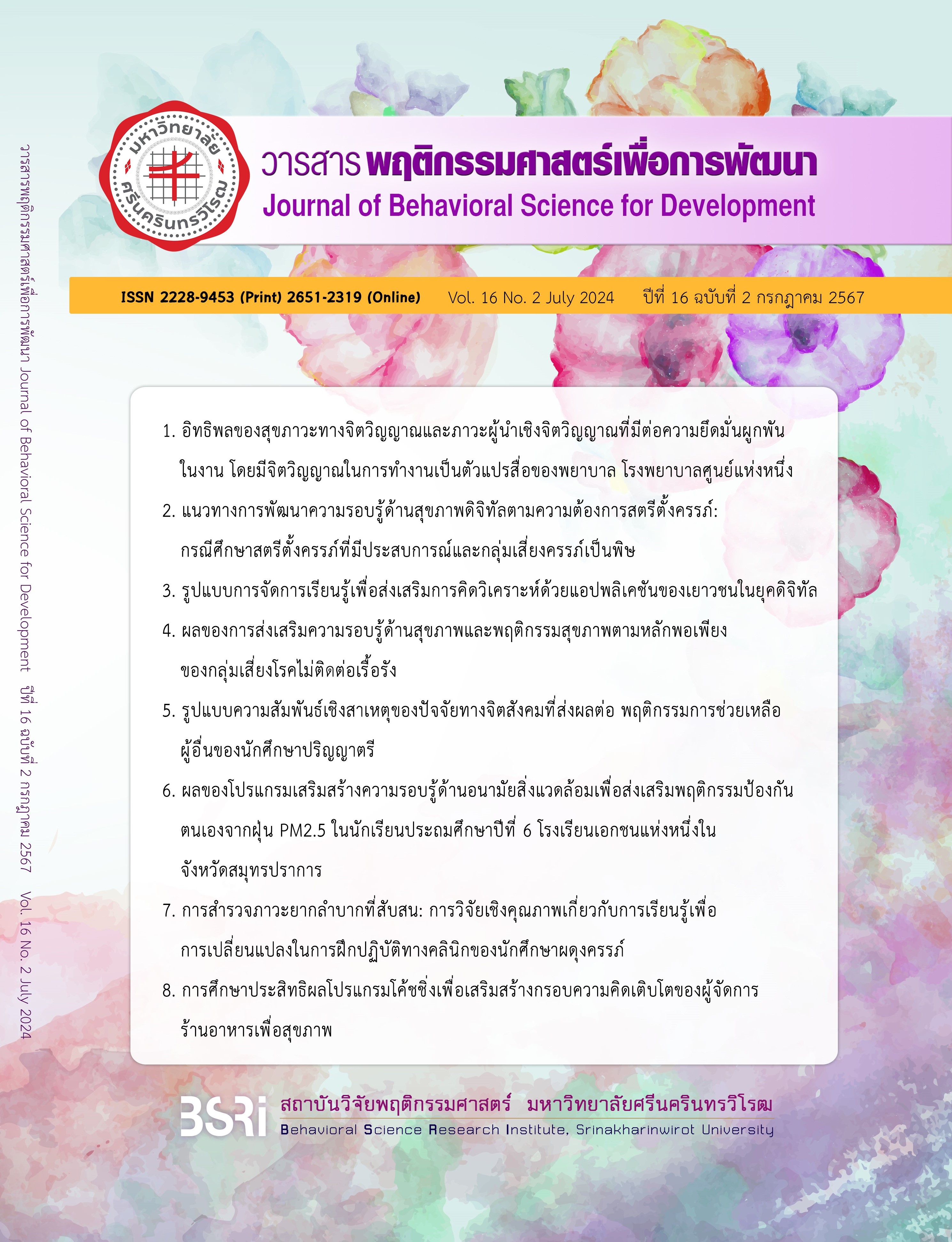
ผลของโปรแกรมเสริมสร้างความรอบรู้ด้านอนามัยสิ่งแวดล้อมเพื่อส่งเสริม พฤติกรรมป้องกันตนเองจากฝุ่น PM2.5 ในนักเรียนประถมศึกษาปีที่ 6 โรงเรียนเอกชนแห่งหนึ่งในจังหวัดสมุทรปราการ
คำสำคัญ:
พฤติกรรมป้องกันตนเองจากฝุ่น PM2.5, ความรอบรู้ด้านอนามัยสิ่งแวดล้อม, นักเรียนประถมศึกษาปีที่ 6บทคัดย่อ
การวิจัยนี้เป็นการวิจัยกึ่งทดลองมีวัตถุประสงค์ เพื่อศึกษาประสิทธิผลของโปรแกรมเสริมสร้างความรอบรู้ด้านอนามัยสิ่งแวดล้อมเพื่อส่งเสริมพฤติกรรมป้องกันตนเองจากฝุ่น PM2.5 ของนักเรียนประถมศึกษาปีที่ 6 จำนวน 50 คน โดยสุ่มเป็นกลุ่มทดลอง 25 คน และกลุ่มควบคุม 25 คน ตามคุณสมบัติเกณฑ์คัดเข้า เครื่องมือที่ใช้ได้แก่ โปรแกรมเสริมสร้างความรอบรู้ด้านอนามัยสิ่งแวดล้อม และแบบวัดพฤติกรรมป้องกันตนเองจากฝุ่น PM2.5 วิเคราะห์ข้อมูลด้วยสถิติ 2 Way Repeated Measure ANOVA ผลการศึกษาพบว่าในระยะหลังการทดลองนักเรียนที่ได้รับโปรแกรมเสริมสร้างความรอบรู้ด้านอนามัยสิ่งแวดล้อมมีคะแนนพฤติกรรมป้องกันตนเองจากฝุ่น PM2.5 สูงกว่านักเรียนที่ไม่ได้รับโปรแกรมฯ อย่างมีนัยสำคัญทางสถิติที่ระดับ.05 และในระยะติดตามผล 6 สัปดาห์ของนักเรียนกลุ่มทดลองที่ได้รับโปรแกรมฯ มีคะแนนพฤติกรรมป้องกันตนเองจากฝุ่น PM2.5 สูงขึ้นกว่าระยะหลังทดลองอย่างมีนัยสำคัญทางสถิติที่ระดับ.05 นอกจากนี้โปรแกรมฯช่วยให้นักเรียนเกิดการเปลี่ยนแปลงพฤติกรรมและยังเกิดความคงทนของพฤติกรรมป้องกันตนเองจากฝุ่น PM2.5 จากผลการวิจัยแสดงให้เห็นว่าโปรแกรมเสริมสร้างความรอบรู้ด้านอนามัยสิ่งแวดล้อมมีประสิทธิผลในการส่งเสริมให้นักเรียนมีพฤติกรรมป้องกันตนเองจากฝุ่น PM2.5 เพิ่มขึ้น
เอกสารอ้างอิง
Al Muhdhar, I., Khuluq, C., Mardiyanti, L., Iskandar, I., & Selfiati, D. (2023). The relationship between self-efficacy and environmental literacy of high school students. AIP Conference Proceedings (Vol. 2569). Malang, Indonesia. https://doi.org/10.1063/5.0112740
Alvarez, E. B., Castillo, F. P., Navarro, R. J., Muñoz, M. C., & Boso, G. A. (2022). Self-protective behaviors against air pollution and psychosocial factors, Temuco, Chile. Revista Internacional de Contaminacion Ambiental, 38, 11-26.
Cheewatrakun, T. (2021). Effectiveness of Environmental Health Literacy Enhancement Program with Case-Based Learning on The Environment Managing Behavior for The Dependency Elderly Among Village Health Volunteer (Master's thesis). Srinakharinwirot University, Bangkok. [in Thai]
Davis, L. F., Ramirez-Andreotta, M. D., McLain, J. T., Kilungo, A., Abrell, L., & Buxner, S. (2018). Increasing environmental health literacy through contextual learning in communities at risk. International Journal of Environmental Research and Public Health, 15(10), 2203. https://doi.org/10.3390/ijerph15102203
Elshaer, S., Martin, J. L., Baker, A. T., Roberts, E., Rios-Santiago, P., Kaufhold, R., & Kovacic, B. M. (2023). Environmental Health Knowledge Does Not Necessarily Translate to Action in Youth. Int J Environ Res Public Health, 20(5), 3971. https://doi.org/10.3390/ijerph20053971
Fan, H., Chen, C., Tsai, J., Chiang, K., Tsai, S. C., Huang, C., Lin, C., Hsu, Y. C., & Chang, K. (2022). Association between Exposure to Particulate Matter Air Pollution during Early Childhood and Risk of Attention-Deficit/Hyperactivity Disorder in Taiwan. International Journal of Environmental Research and Public Health, 19(23). https://doi.org/10.3390/ijerph192316138
Finn, S., & O’Fallon, L. (2017). The Emergence of Environmental Health Literacy-From Its Roots to Its Future Potential. Environmental Health Perspectives, 125(4), 495-501. https://doi.org/doi:10.1289/ehp.1409337
Gray, M. K. (2018). From Content Knowledge to Community Change: A Review of Representations of Environmental Health Literacy. International Journal of Environmental Research and Public Health, 15(3), 466. https://doi.org/10.3390/ijerph15030466
Hamann, K. S., Wullenkord, M. C., & Zomeren, V. M. (2024). Believing that we can change our world for the better: A triple-A (Agent-Action-Aim) framework of self-efficacy beliefs in the context of collective social and ecological aims. Sage Journals, 28. https://doi.org/10.1177/10888683231178
Hermayurisca, F. (2021). Evaluation of health impacts from fine particulate matter PM2.5 in Thailand (Master's thesis). Chulalongkorn University, Bangkok. [in Thai]
Im-man, K., Im-man, S., Polmak, C., & Woraritphunpol, P. (2023). Factors related to environmental health literacy and behavior in preventing PM 2.5 dust for preschool children's parents in child development centers. Nursing and Health Science Journal, 43(1), 146-156. https://he02.tci-thaijo.org/index.php/nur-psu/article/view/260368/178990 [in Thai]
Intarakamhang, U. (2020). Developing a situation on environmental health literacy in preventing health effects from particulate matter with a diameter of not more than 2.5 microns (PM2.5) among village health volunteers in eco-industrial town areas. http://bsris.swu.ac.th/upload/319381.pdf [in Thai]
Irawati, A. H., Chusnul, K. R., Mardiyanti, L., Iskandar, I., & Selfiati, R. D. (2023). The relationship between self-efficacy and environmental literacy of high school students. AIP Conference Proceedings, 2569, 020003. Malang, Indonesia. https://doi.org/10.1063/5.0112740
Jeewatrakul, T. (2021). Effects of an environmental health literacy promotion program using case-based learning on environmental management behaviors for dependent elderly among village health volunteers (Doctoral dissertation). Srinakharinwirot University, Bangkok. [in Thai]
Kamket, W. (2012). Research methodology in behavioral science. Bangkok: Department of Research and Educational Psychology. Faculty of Education, Chulalongkorn University, Bangkok. [in Thai]
Karyadi, B., Ansori, I., & Aswin, P. (2019). Understanding Skill of Junior High School Students on Environmental Pollution Topic by Environmental-based Science Learning. Journal of Physics: Conference Series 1233. https://doi.org/10.1088/1742-6596/1233/1/012011
Kwak, J., & Kim, J. (2022). Psychometric Properties of the Korean Version of the Environmental Health Literacy Scale. International Journal of Environmental Research and Public Health, 19(7), 4079. https://www.mdpi.com/1660-4601/19/7/4079
Kim, H. K., & Kim, Y. (2021). Protective behaviors against particulate air pollution: Self-construal, risk perception, and direct experience in the theory of planned behavior. Environmental Communication, 15(8), 1092–1108. https://doi.org/10.1080/17524032.2021.1944891
Kim, J., Moon, N., Heo, S., & Kwak, J. (2024). Effects of environmental health literacy-based interventions on indoor air quality and urinary concentrations of polycyclic aromatic hydrocarbons, volatile organic compounds, and cotinine: A randomized controlled trial. Atmospheric Pollution Research, 15(1), 101965. https://doi.org/https://doi.org/10.1016/j.apr.2023.101965
Kosolkittiamphon, S. (2020). Assumption Test of One-way Analysis of Variance in Social Science Research. Yala Rajabhat University Journal, 15(1). https://so04.tcithaijo.org/index.php/yru_human/article/view/176004/162399 [in Thai]
Laitaisong, T., & Tullatorn, S. (2020). Acute effects of PM2.5 from biomass burning on hospital visits for asthma at Maesot Hospital, Tak Province. Journal of the Preventive Medicine Association of Thailand, 10(1), 36-48. https://he01.tci-thaijo.org/index.php/JPMAT/article/download/242208/164712/840472 [in Thai]
Lebow-Skelley, E., Fremion, B. B., Quinn, M., Makled, M., Keon, B. N., Jelenek, J., Crowley, J., Pearson, A. M., & Schulz, J. A. (2022). They Kept Going for Answers: Knowledge, Capacity, and Environmental Health Literacy in Michigan's PBB Contamination. Int J Environ Res Public Health, 19(24). https://doi.org/10.3390/ijerph192416686
Lee, J., Yang, S., Zajchowski, C. B., & Kim, H. (2024). Communicating particulate matter risk: The effects of empoweredness and trust in government information on protective behaviour. International Journal of Urban Sciences, 1–25. https://doi.org/10.1080/12265934.2024.2344456
Mahinay, A. H., Marapao, S. M., Jempero, B. J., & Allawan, G. J. (2023). Environmental Literacy Levels and Environmental Pollution among Senior High School Students Environment. Journal of Environmental Impact and Management Policy, 03(6). https://doi.org/https://doi.org/10.55529/jeimp.36.17.25
Min, J., & Min, K. (2017). Exposure to ambient PM(10) and NO(2) and the incidence of attention-deficit hyperactivity disorder in childhood. Environ Int, 99, 221-227. https://doi.org/10.1016/j.envint.2016.11.022
Mishra, P., Pandey, C. M., Singh, U., Gupta, A., Sahu, C., & Keshiri, A. (2019). Descriptive statistics and normality tests for statistical data. Annals of Cardiac Anaesthesia, 22(1), 67-72. https://doi.org/10.4103/aca.ACA_157_18
Namjarasruengsri, M., Duangsawat, S., & Prabkhasorn, T. (2020). Development of health literacy in preventing health effects from particulate matter with a diameter of not more than 2.5 microns (PM2.5): A case study of Thungsonghongvittaya 1 School, Bangkok. https://mwi.anamai.moph.go.th/th/mwiresearch/download?id=87144&mid=36865&mkey=m_document&lang=th&did=28106 [in Thai]
Phungket, Y., Bunprom, P., Thongkhaimuk, B., Saengsiriwut, N., & Sirijunvong, U. (2022). Perception and self-protection behavior against particulate matter of personnel: A case study of an organization in Bangkok. MSCU Academic Journal, 26(1), 98-107. https://he01.tci-thaijo.org/index.php/HCUJOURNAL/article/view/255115/173756 [in Thai]
Pullu, E., & Gömleksiz, M. N. (2024). The Self-Efficacy Perception for Environmental Education and Ecological Footprint Awareness of the Child Development Programe Students. Discourse and Communication for Sustainable Education, 14, 62-74. https://doi.org/10.2478/dcse-2023-0018
Seebunrin, S. (2019). Air pollution prevention behavior of secondary school students at Wat Mongkolnimit School (Mongkolpittayakarn) (Master's thesis). Silpakorn University. [in Thai]
Sitthiyot, S., Wongruang, P., & Laemlag, P. (2022). Environmental health literacy and PM2.5 prevention behaviors of highland youth during open burning in Phayao Province, Thailand. Academic Journal of Community Public Health. https://he02.tci-thaijo.org/index.php/ajcph/article/view/258411/178411 [in Thai]
Sritongpim, J., Narin, R., & Tueanrat, W. (2021). Effects of health literacy promotion program on health literacy and prevention practices of coronavirus disease 2019 among people with chronic diseases in community. Lanna Public Health Journal, 18(2), 30-42. https://he02.tci-thaijo.org/index.php/LPHJ/article/view/258775/177803 [in Thai]
Supornpraditchai, T. (2021). Population characteristics, self-protection behavior, and self-health assessment of people in areas with high PM 2.5 concentrations in Bangkok. North Bangkok University Academic Journal, 10(2). [in Thai]
Suteetorn, K. (2022). Project to assess health and develop an action plan for caring for large trees in Chulalongkorn University. [in Thai]
Thygesen, M., Holst, G. J., Hansen, B., Geels, C., Kalkbrenner, A., Schendel, D., Brandt, J., Pedersen, C. B., & Dalsgaard, S. (2020). Exposure to air pollution in early childhood and the association with Attention-Deficit Hyperactivity Disorder. Environ Res, 183, 108930. https://doi.org/10.1016/j.envres.2019.108930
Thinyuenyong, W., Busarangsri, A., Thawatsupa, B., & Chatwilai, N. (2017). Environmental threats and health of public transport workers. Public Health Academic Journal, 26(3). https://drive.google.com/file/d/1UVORE_G7M6EB-Vw-kgeaDgIyfGp8Hlo0/view [in Thai]
WHO. (2018). Ambient (outdoor) air quality and health. https://smartairfilters.com/wordpress/wp-content/uploads/2018/03/https-www.who_.intennews-roomfact-sheetsdetailambient-outdoor-air-quality-and-health.pdf
Wichaino, P., Jearajit, C., & Panyachit, S. (2022). Risk perception and impacts of PM2.5 dust among urban industrial people in Samut Prakan Province. Journal of Social Sciences and Humanities, 22(2). [in Thai]
Yongyu, M. (2022). Health literacy on prevention of health effects from particulate matter less than 2.5 microns (PM2.5) among village health volunteers in Eco-Industrial Town areas, Health Region 5. Thailand Journal of Health Promotion and Environmental Health, 44(2), 83-96. [in Thai]
ดาวน์โหลด
เผยแพร่แล้ว
รูปแบบการอ้างอิง
ฉบับ
ประเภทบทความ
สัญญาอนุญาต
ลิขสิทธิ์ (c) 2024 วารสารพฤติกรรมศาสตร์เพื่อการพัฒนา

อนุญาตภายใต้เงื่อนไข Creative Commons Attribution-NonCommercial-NoDerivatives 4.0 International License.


