
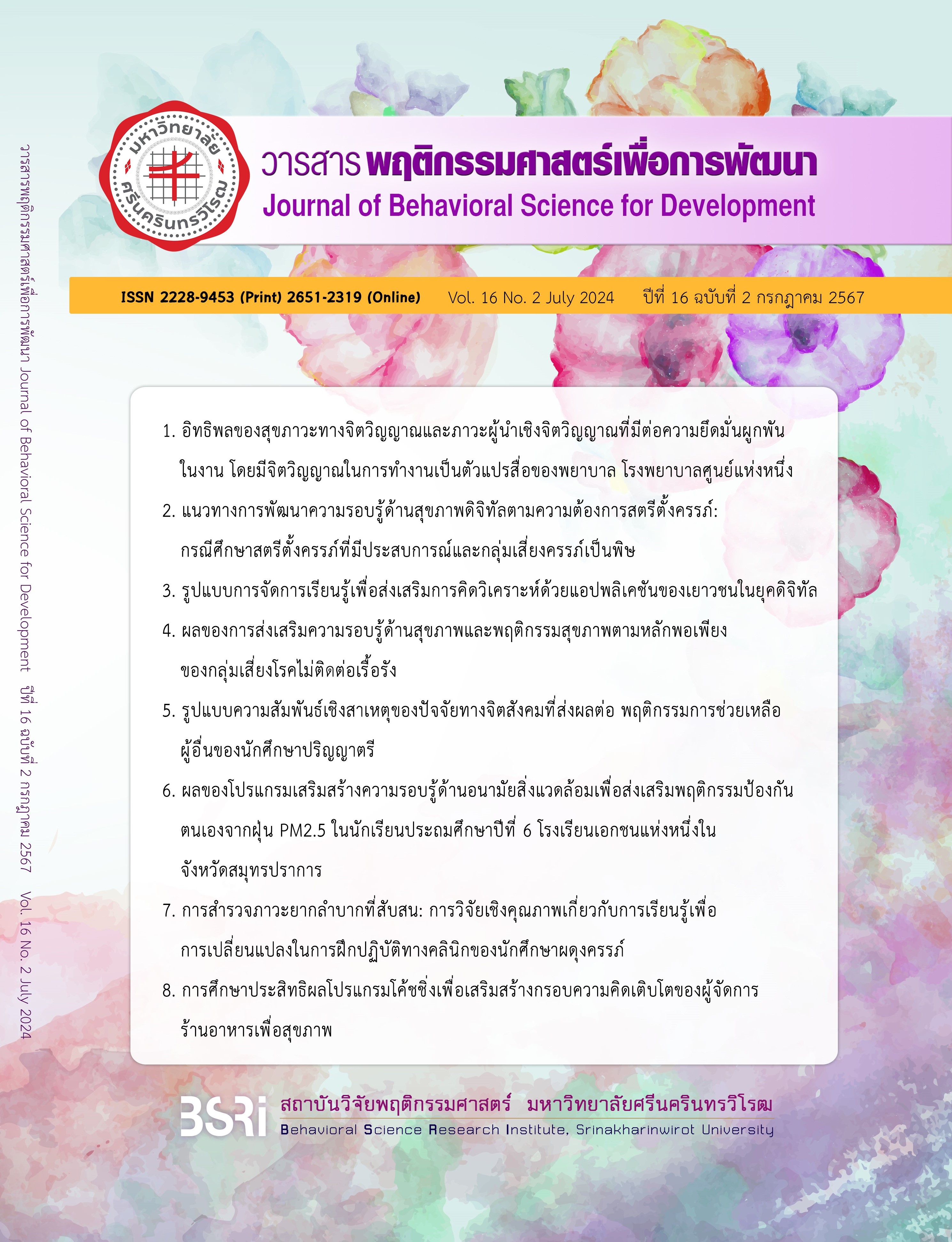
ผลของการส่งเสริมความรอบรู้ด้านสุขภาพและพฤติกรรมสุขภาพตามหลักพอเพียงของกลุ่มเสี่ยงโรคไม่ติดต่อเรื้อรัง
คำสำคัญ:
ความรอบรู้ด้านสุขภาพ, พฤติกรรมสุขภาพ, สุขภาพตามหลักพอเพียง, โรคไม่ติดต่อเรื้อรังบทคัดย่อ
การศึกษาครั้งนี้มีวัตถุประสงค์เพื่อสำรวจและศึกษาผลของใช้ชุดกิจกรรมส่งเสริมความรอบรู้ด้านสุขภาพและพฤติกรรมสุขภาพตามหลักพอเพียงของกลุ่มเสี่ยงโรคไม่ติดต่อเรื้อรังที่อาศัยอยู่ในชุมชน โดยผู้วิจัยได้ทำการศึกษาแบบพหุวิธีในช่วงเดือนกรกฎาคม ถึง ธันวาคม 2564 ด้วยการสำรวจข้อมูลระดับความรอบรู้ด้านสุขภาพ ด้วยแบบวัดที่มีค่าอำนาจจำแนกของแบบวัดอยู่ในช่วง 0.20 ถึง 0.86 และตามด้วยการทดลองใช้ชุดกิจกรรมโดยจัดเรียนรู้ผ่าน Zoom โดยมีบุคลากรสุขภาพแกนนำร่วมกับนักวิจัยเป็นผู้สอนและประเมินผลเบื้องต้น ผลการวิจัยพบว่า กลุ่มเสี่ยงวัยทำงานส่วนใหญ่มีระดับความรอบรู้ด้านสุขภาพอยู่ในระดับดีมาก ร้อยละ 65.15 รองลงมาอยู่ในระดับพอใช้ได้ ร้อยละ 31.24 และระดับไม่ดีพอ ร้อยละ 3.61 ตามลำดับ และระดับพฤติกรรมอยู่ในระดับปฏิบัติมาก ร้อยละ 45.68 รองลงมาอยู่ในระดับปฏิบัติบางครั้ง ร้อยละ 45.21 และระดับปฏิบัติน้อย ร้อยละ 9.11 ตามลำดับ ภายหลังการใช้ชุดกิจกรรม ผู้เข้าร่วมกิจกรรม มีค่าเฉลี่ยของความรอบรู้ด้านสุขภาพและพฤติกรรมสุขภาพตามหลักพอเพียง สูงกว่าก่อนเข้าร่วมกิจกรรมอย่างมีนัยสำคัญทางสถิติ (p < .05) และบุคลากรสุขภาพแกนนำให้ข้อมูลให้มีการปรับโครงสร้างเนื้อหากิจกรรมให้ชัดเจนเป็น 3 ทักษะคือ ส่งเสริมทักษะความรอบรู้ด้านสุขภาพ ทักษะการปรับพฤติกรรมสุขภาพ และทักษะการสื่อสารสุขภาพ จึงกล่าวได้ว่า ชุดกิจกรรมนี้มีประสิทธิผลต่อกลุ่มเสี่ยงโรค NCDs และสามารถนำไปใช้ในกลุ่มเสี่ยงโรคไม่ติดต่อเรื้อรังได้
เอกสารอ้างอิง
Abedini, A., Abedin, B., & Zowghi, D. (2023). A framework of environmental, personal, and behavioral factors of adult learning in online communities of practice. Information Systems Frontiers, 26(3), 1-18.
Arpanantikul, M. (2018). Sufficient Health. Thai Journal of Nursing Council, 33(2). 5-14.
Arpanantikul, M., Phuphaibul, R., & Khuwatsamrit, K. (2015). Analysis and integration of Sufficiency Health Indicators with the Sufficiency Economy Philosophy concept. Thai Journal of Nursing Council, 30(1), 41-57.
Bandura, A. (1986). The explanatory and predictive scope of self-efficacy theory. Journal of Social and Clinical Psychology, 4(3), 359–73.
Benny, M. E., Kabakian-Khasholian, T., El-Jardali, F., & Bardus, M. (2021). Application of the eHealth literacy model in digital health interventions: Scoping review. The Journal of Medical Internet Research, 23(6), e23473.
Brega, A. G., Ang, A., Vega, W., Jiang, L., Beals, J., Mitchell, C. M., Moore, K., Manson, S. M., Acton, K. J., & Roubideaux, Y. (2012). Mechanisms underlying the relationship between health literacy and glycemic control in American Indian and Alaska Natives. Patient Education and Counseling, 88, 61–68.
Buchner, A. (2010). G*Power: Users Guide-Analysis by design. Web Page of Heinrich-HeineUniversität - Institut für experimentelle Psychologie. http://www.psycho.uniduesseldorf.de/abteilungen/aap/gpower3
Cohen, J. (1977). Statistical power analysis for the behavioral sciences. Academic Press.
Department of Disease Control (2023). Health Condition Survey and Screening Report. Issue of Non-communicable Diseases through Application Smart, village health volunteers, year 2023. Ministry of Public Health.
Department of Health Service Support. (2015). Guidelines for Promoting Health Literacy and Developing Health Behaviors. In the Health Management Subdistrict. Ministry of Public Health.
Edwards, M., Wood, F., Davies, M., & Edwards, A. (2012). The development of health literacy in patients with a long-term health condition: The health literacy pathway model. BMC Public Health, 12(130), 1-15.
Foroushani, P. S., Travaglia, J., Debono, D., & Braithwaite, J. (2014). Implementing strategies in consumer and community engagement in health care: Results of a large-scale, scoping meta-review. BMC Health Services Research, 14, 402.
Gordon, T. D. (2021). Technology integration leaders: A Leaders’ community of practice to negotiate meaning, craft a vision, and establish value (Doctoral dissertation). Johns Hopkins University. https://jscholarship.library.jhu.edu/items/d4eb5925-c805-42eb-8851-77994a12bcd8
Hacihasanoglu, R., & Gozum, S. (2011). The effect of patient education and home monitoring on medication compliance, hypertension management, healthy lifestyle behaviors and BMI in a primary health care setting. Journal of Clinical Nursing, 20(5-6), 629-705. http://dx.doi.org/10.1111/j.1365-2702.2010.03534.x
Hsu, W., Chiang, C., & Yang, S. C. (2014). The Effect of individual factors on health behaviors among college students: The mediating effects of eHealth literacy. Journal of Medical Internet Research, 16(12), e287.
Intarakamhang, U., & Intarakamhang, P. (2017). Health literacy scale and causal model of childhood overweight. Journal of Research in Health Science, 17, e00368.
Intarakamhang, U., & Kwanchuen, Y. (2016). The development and application of the ABCDE-health literacy scale for Thai adults. Asian Biomedicine, 10(6), 587-594.
Intarakamhang, U., & Macaskill, A. (2018). Multi-group causal model of health literacy and behaviors on family wellbeing among Thai adults at risk of Non-Communicable Diseases (NCDs). Journal of Research in Health Science, 18, e00429.
Intarakamhang, U., & Prasittichok, P. (2022). Causal model of health literacy in dietary supplement use and sufficient health behavior among working-age adults. Heliyon, 8(11), e11535.
Intarakamhang, U., Khammungkul, J., & Boocha, P. (2022). General health literacy scale for Thais and comparison between age groups. Heliyon, 8(5), e09462.
Intarakamhang, U., Sriprasertpap, K., Chiangkhong, A., Srisawasdi, N., Wongchan, S., Intarakamhang, P., & Boocha, P. (2022). Construct validity of health literacy scales and causal model of sufficient health among NCDs risk adults. Journal of the Medical Association of Thailand, 105(12), 1259-66.
Knowles, M. S. (1980). The modern practice of adult education: From pedagogy to andragogy. Prentice Hall/Cambridge.
Manafo, E., & Wong, S. (2012). Health literacy programs for older adults: a systematic literature review. Health Education Research, 27(6), 947-60. http://dx.doi.org/10.1093/her/cys067
Manganello, J. A. (2008). Health Literacy and adolescents: A framework and agemda for future research. Health Education Research, 23(5), 840-847. http://dx.doi.org/10.1093/her/cym069
Nutbeam, D. (2000). Health literacy as a public health goal: A challenge for contemporary health education and strategies into the 21st century. Health Promotion International, 15(3), 259-267. http://dx.doi.org/10.1093/heapro/15.3.259
Nutbeam, D. (2008). The evolving concept of health literacy. Social Science & Medicine, 67(12), 2072-8.
Osborne, R. H., Batterham, R. W., Elsworth, G. R., Hawkins, M., & Buchbinder, R. (1998). The grounded psychometric development and initial validation of the Health Literacy Questionnaire (HLQ). BMC Public Health, 13, 658. http://dx.doi.org/10.1186/1471-2458-13-658
Pender, N. J., Murdaugh, C. L., & Parsons, M. A. (2006). Health promotion in nursing practice (5th ed.). Pearson Education.
Sherer, P., Shea, T., & Kristensen, E. (2003). Online communities of practice: A catalyst for faculty development. Innovative Higher Education, 27, 183–194.
SØrensen, K., Van den Broucke, S., Fullam, J., Doyle, G., Pelikan, J., Slonska, Z., & Brand, H. (2012). Health literacy and public health: A systematic review and integration of definitions and models. BMC Public Health, 12(80), 1-13. http://dx.doi.org/10.1186/1471-2458-12-80
Strategy and Planning Division. (2020). Public Health Statistics 2019. Strategy and Planning Division, Ministry of Public Health.
Thiamwong, L., Maneesriwongul, W., Malathum, P., Jitapunkul, S., Vorapongsathorn, T., & Stewart A. L. (2008). Development and psychometric testing of the healthy aging instrument. Thai Journal of Nursing, 12(4), 285-296.
Vamos, S., & Yeung, P. (2016). Development of a core online health literacy course in Canada. Pedagog. Health Promot. 3, 90–99. http://dx.doi.org/10.1177/2373379916662481
Vamos, S., Okan, O., Sentell, T., & Rootman, I. (2020). Making a case for “Education for health literacy”: An international perspective. International Journal of Environmental Research and Public Health, 17, 1436. http://dx.doi.org/10.3390/ijerph17041436
Weerdmeester, J., van Rooij, M. M. J. W., Engels, R. C. M. E., & Granic, I. (2020). An integrative model for the effectiveness of biofeedback interventions for anxiety regulation: Viewpoint. The Journal of Medical Internet Research, 22(7), e14958.
WHO. (1998). Health promotion Glossar. Geneva: WHO promotion glossary Publications.
ดาวน์โหลด
เผยแพร่แล้ว
รูปแบบการอ้างอิง
ฉบับ
ประเภทบทความ
สัญญาอนุญาต
ลิขสิทธิ์ (c) 2024 วารสารพฤติกรรมศาสตร์เพื่อการพัฒนา

อนุญาตภายใต้เงื่อนไข Creative Commons Attribution-NonCommercial-NoDerivatives 4.0 International License.


