
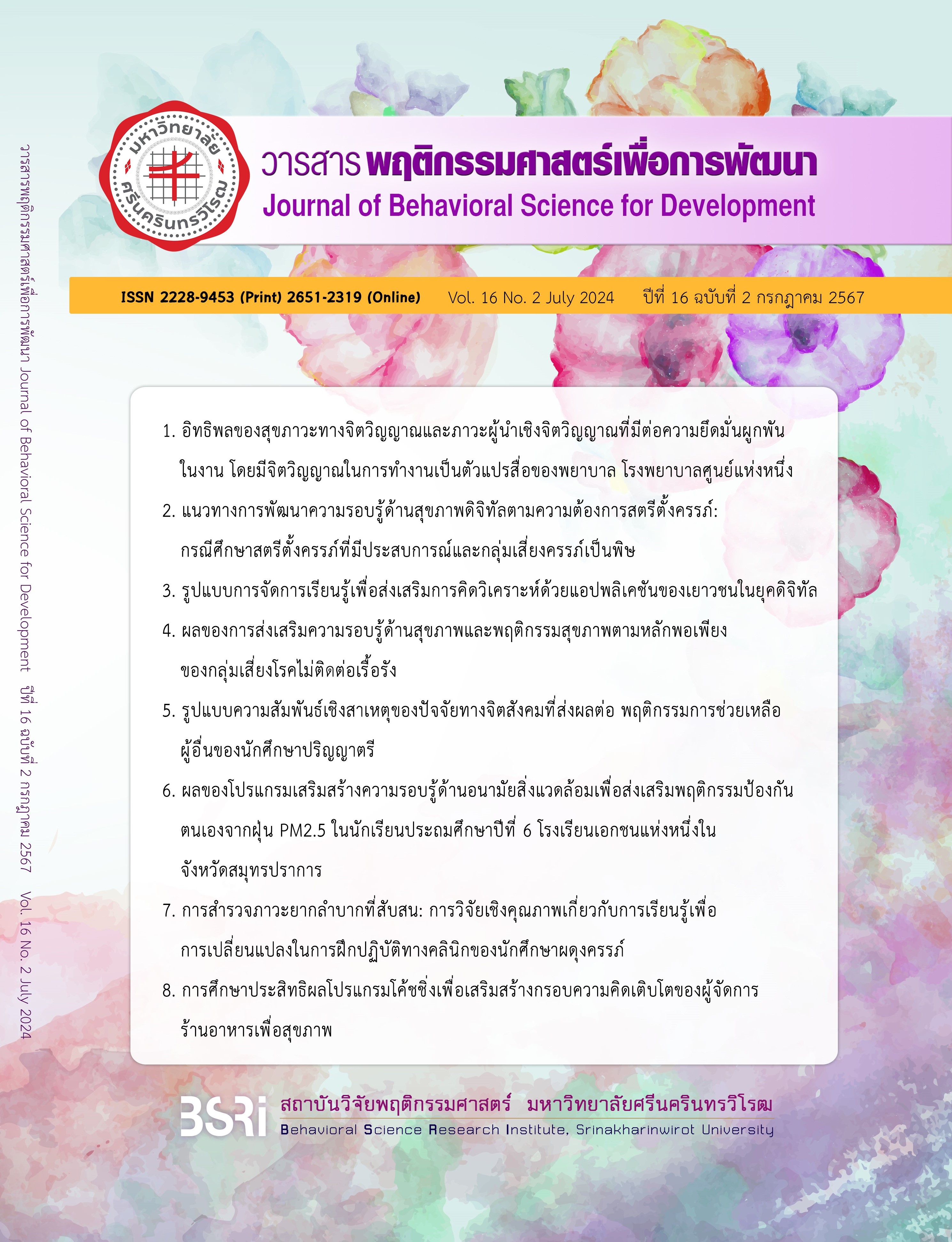
แนวทางการพัฒนาความรอบรู้ด้านสุขภาพดิจิทัลตามความต้องการสตรีตั้งครรภ์:กรณีศึกษาสตรีตั้งครรภ์ที่มีประสบการณ์และกลุ่มเสี่ยงครรภ์เป็นพิษ
คำสำคัญ:
พัฒนาความรอบรู้ด้านสุขภาพดิจิทัล, สตรีตั้งครรภ์, กลุ่มเสี่ยงครรภ์เป็นพิษบทคัดย่อ
วิจัยมีวัตถุประสงค์ 1) ทำความเข้าใจพฤติกรรมป้องกันภาวะครรภ์เป็นพิษและการส่งเสริมความรอบรู้ด้านสุขภาพดิจิทัล 2) ค้นหาอุปสรรค ความต้องการและแนวทางออกแบบโปรแกรมพัฒนาความรอบรู้ด้านสุขภาพดิจิทัลเพื่อป้องกันภาวะครรภ์เป็นพิษ เก็บรวบรวมด้วยการสัมภาษณ์เชิงลึกผู้ให้ข้อมูลหลักและรอง แบ่งเป็นสตรีตั้งครรภ์ที่มีภาวะครรภ์เป็นพิษ จำนวน 3 คน และสตรีตั้งครรภ์ที่มีภาวะเสี่ยงครรภ์เป็นพิษ จำนวน 5 คน ผู้ให้ข้อมูลรอง สามีสตรีตั้งครรภ์ จำนวน 3 คน และพยาบาล จำนวน 4 คน ผลวิเคราะห์ข้อมูลเชิงเนื้อหา พบว่าความหมายความรอบรู้ด้านสุขภาพดิจิทัล คือการใช้อุปกรณ์อิเล็กทรอนิคส์ค้นหาข้อมูลมาดูแลสุขภาพ พฤติกรรมป้องกันภาวะครรภ์เป็นพิษเป็นการปฏิบัติไม่ให้เกิดครรภ์เป็นพิษ อุปสรรคสาเหตุมาจาก 1) ไม่สามารถเข้าถึงแหล่งข้อมูล 2) ขาดการจัดการตนเอง 3) ขาดการสนับสนุนช่วยเหลือ 4) ทัศนคติด้านลบ และ 5) ปฏิบัติตามคำแนะนำแพทย์ได้ไม่ต่อเนื่อง ความต้องการจำเป็น 1) ทักษะการใช้เทคโนโลยีเพื่อสืบค้น 2) ทักษะค้นหาข้อมูล 3) ทักษะรู้เท่าทันสื่อ 4) ทักษะจำแนกข้อมูล 5) ทักษะการจัดการตนเอง 6) ความรู้ครรภ์เป็นพิษ แนวทางพัฒนาความรอบรู้ด้านสุขภาพดิจิทัล 1) การเรียนรู้เชิงรุก 2) การสนับสนุน ช่วยเหลือ 3) การเรียนรู้ที่บรรลุทั้งความรู้ ทักษะ และเจตคติ ข้อค้นพบเป็นแนวทางออกแบบโปรแกรมพัฒนาความรอบรู้ด้านสุขภาพดิจิทัลเพื่อป้องกันภาวะครรภ์เป็นพิษ
เอกสารอ้างอิง
Ajzen, I., & Fishbein, M. (1980). Understanding attitudes and predicting social behavior. Prentice-Hall.
American College of Obstetricians and Gynecologists. (2019). Clinical management guidelines for obstetrician-gynecologists [Electronic version]. ACOG Practice Bulletin, 133(1), 1-25.
Bandura, A. (1989). Social cognitive theory. Annals of Child Development, 6, 1-60.
Boonyakiat, S., & Junyam, P. (2017). Self-care behavior of nutrition among pregnant women at prenatal care clinic of Chaopaya Apaipubejhr Hospital. Prachinburi province, 34(4), 270-280. [in Thai]
Clark, D. (2015). Bloom's taxonomy: The psychomotor domain. http://www.nwlink.com/~donclark/hrd/Bloom/psychomotor_domain.html
Chiangkhong, C., & Intarakamhang, U. (2018). Self-directed learning program utilizing simulations, collaborative learning, and digital media for enhancing health literacy among pregnant women in Thailand. Asia-Pacific Journal of Public Health, 30(5), 456-468. https://doi.org/10.1177/1010539518792503 [in Thai]
Dheva-Aksorn, W., & Intarakamhang, U. (2023). Development of a digital health literacy program focusing on online activities to enhance competencies, knowledge, and attitudes towards practice among pregnant women. Journal of Health Literacy Research & Practice, 7(2), 45-58. https://doi.org/10.1177/23888743231027921 [in Thai]
Geboers, B., de Winter, A. F., Luten, K. A., Jansen, C. J., & Reijneveld, S. A. (2014). The association of health literacy with physical activity and nutritional behavior in older adults, and its social cognitive mediators. Journal of Health Communication, 19(2), 61-76.
Geboers, B., Reijneveld, S. A., Koot, J. A. R., & de Winter, A. F. (2018). Moving towards a comprehensive approach for health literacy interventions: The development of a health literacy intervention model. International Journal of Environmental Research and Public Health, 15(6), 1268.
Jaturongkachock, K., Intarasan, T., & Plodpluang, U. (2023). The development of health literacy model for pregnant women at risk of gestational diabetes mellitus in Banpong Hospital. Region 4-5 Medical Journal, 42, 431-444. [in Thai]
Miles, M. B., & Huberman, A. M. (1994). Qualitative data analysis: An expanded source. https://vivauniversity.files.wordpress.com/2013/11/milesandhuberman1994.pdf
Lahti-Pulkkinen, M., Girchenko, P., Tuovinen, S., Sammallahti, S., Reynolds, R., Lahti, J., Heinonen, K., Lipsanen, J., Hamalainen, E., Villa, P. M., Kajantie, E., Laivuori, H., & Raikkonen, K. (2020). Maternal hypertensive pregnancy disorders and mental disorders in children. Hypertension. https://doi.org/10.1161/HYPERTENSIONAHA.119.14140
Podhisita, C. (2019). Qualitative research. Amarin Printing & Publishing.
Rasouli, M., Pourheidari, M., & Gardesh, Z. H. (2019). Effect of self-care before and during pregnancy to prevention and control preeclampsia in high-risk women. International Journal of Preventive Medicine, 10.
Sørensen, K., Van den Broucke, S., Fullam, J., Doyle, G., Pelikan, J., Slonska, Z., & Brand, H. (2012). Health literacy and public health: A systematic review and integration of definitions and models. BMC Public Health, 12(1), 1-13.
Sørensen, K., & Brand, H. (2013). Health literacy lost in translations: Introducing the European health literacy glossary. Health Promotion International. https://academic.oup.com/heapro/article/28/4/575/664558
Strategy and Planning Division. (2019). Public health statistics A.D. 2018. http://bps.moph.go.th /new_bps/sites/default/files/statistic%2061.pdf [in Thai]
Wolf, M. S., Davis, T. C., Curtis, L. M., Webb, J. A., Bailey, S. C., & Shrank, W. H. (2011). Effect of standardized, patient-centered label instructions to improve comprehension of prescription drug use. Medical Care, 49(1), 96–100.
World Health Organization. (2019). Trends in maternal mortality 2000 to 2017. https://www.who.int/news-room/fact-sheets/detail/maternal-mortality
Youssef, G. S. (2019). Hypertension in pregnancy. European Society of Cardiology, 22(17). https://www.escardio.org/Journals/E-Journal-of-Cardiology-Practice/Volume-17/hypertension-in-pregnancy
ดาวน์โหลด
เผยแพร่แล้ว
รูปแบบการอ้างอิง
ฉบับ
ประเภทบทความ
สัญญาอนุญาต
ลิขสิทธิ์ (c) 2024 วารสารพฤติกรรมศาสตร์เพื่อการพัฒนา

อนุญาตภายใต้เงื่อนไข Creative Commons Attribution-NonCommercial-NoDerivatives 4.0 International License.


