
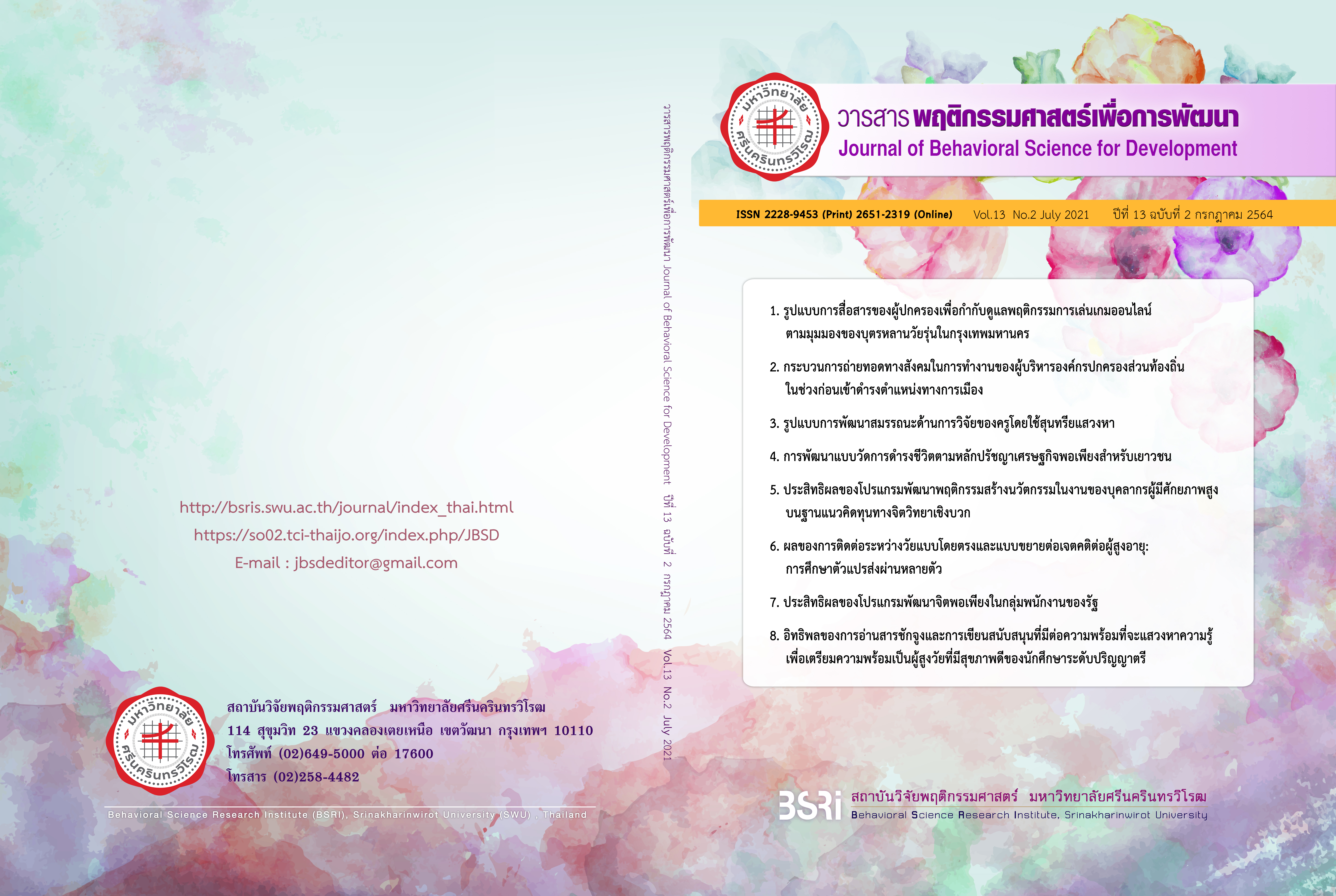
ผลของการติดต่อระหว่างวัยแบบโดยตรงและแบบขยายต่อเจตคติต่อผู้สูงอายุ: การศึกษาตัวแปรส่งผ่านหลายตัว
คำสำคัญ:
การติดต่อระหว่างกลุ่ม, การติดต่อระหว่างวัย, เจตคติต่อผู้สูงอายุ, วยาคติ, เจตคติรังเกียจกลุ่มบทคัดย่อ
ประเทศไทยกำลังเผชิญกับอัตราการเพิ่มขึ้นของประชากรผู้สูงอายุอย่างฉับพลันเป็นผลให้เกิดความสนใจในประเด็นเจตคติทางลบต่อผู้สูงอายุมากขึ้น งานวิจัยที่ผ่านมาพบว่าการติดต่อระหว่างวัยทางบวกสามารถเพิ่มเจตคติทางบวกต่อผู้สูงอายุได้ การวิจัยครั้งนี้มีวัตถุประสงค์ 1) เพื่อศึกษาบทบาทการเป็นตัวแปรส่งผ่านของความวิตกกังวลระหว่างกลุ่ม และความวิตกกังวลต่อการสูงอายุ ในอิทธิพลของการติดต่อระหว่างวัยแบบโดยตรงที่มีต่อเจตคติต่อผู้สูงอายุ และ2) เพื่อศึกษาบทบาทการเป็นตัวแปรส่งผ่านของความวิตกกังวลระหว่างกลุ่ม ความวิตกกังวลต่อการสูงอายุ และบรรทัดฐานของกลุ่ม ในอิทธิพลของการติดต่อระหว่างวัยแบบขยายที่มีต่อเจตคติต่อผู้สูงอายุ ผลการศึกษาจาก นิสิตนักศึกษาระดับปริญญาตรี จำนวน 554 คน พบว่าการติดต่อระหว่างวัยแบบโดยตรงมีอิทธิพลทางบวกต่อเจตคติต่อผู้สูงอายุโดยส่งผ่านการลดความวิตกกังวลระหว่างกลุ่ม แต่ความวิตกกังวลต่อการสูงอายุไม่ได้มีบทบาทการเป็นตัวแปรส่งผ่าน นอกจากนี้การติดต่อระหว่างวัยแบบขยายไม่ได้มีอิทธิพลต่อเจตคติต่อผู้สูงอายุ ข้อค้นพบนี้สามารถนำไปใช้ในการออกแบบวิธีการเพิ่มเจตคติทางบวกต่อผู้สูงอายุ โดยการเพิ่มคุณภาพและความถี่ในการติดต่อพบเจอกับผู้สูงอายุ รวมทั้งฝึกวิธีการลดความวิตกกังวลในการมีปฏิสัมพันธ์กับผู้สูงอายุ
เอกสารอ้างอิง
Allan, L. J., & Johnson, J. A. (2009). Undergraduate attitudes toward the elderly: The role of knowledge, contact and aging anxiety. Educational Gerontology, 35(1), 1-14. http://doi:10.1080/03601270802299780
Allan, L. J., Johnson, J. A., & Emerson, S. D. (2014). The role of individual difference variables in ageism. Personality and Individual Differences, 59, 32–37. https://doi.org/10.1016/j.paid.2013.10.027
Allport, G. W. (1954). The nature of prejudice. Cambridge, MA: Perseus Books.
Allport, G. W. (1967). Reading in attitude theory and measurement. New York: John Willey & Sons.
Bousfield, C., & Hutchison, P. (2010). Contact, anxiety, and young people's attitudes and behavioral intentions towards the elderly. Educational Gerontology, 36(6), 451-466. https://doi:10.1080/03601270903324362
Brown, R. J. (2010). Prejudice: Its social psychology (2nd ed.). New York: Wiley & Sons.
Cameron, L., Rutland, A., Hossain, R., & Petley, R. (2011). When and why does extended contact work? The role of high quality direct contact and group norms in the development of positive ethnic intergroup attitudes amongst children. Group Processes & Intergroup Relations, 14(2), 193–206. https://doi.org/10.1177/1368430210390535
Caspi, A. (1984). Contact hypothesis and inter-age attitudes: A field-study of cross-age contact. Social Psychology Quarterly, 47(1), 74–80. https://doi.org/10.2307/3033890
Chonody, J. M., Webb, S. N., Ranzijn, R., & Bryan, J. (2014). Working with older adults: Predictors of attitudes towards ageing in psychology and social work students, faculty, and practitioners. Australian Psychologist, 49(6), 374-383. https://doi:10.1111/ap.12056
Cialdini, R. B., Kallgren, C. A., & Reno, R. R. (1991). A focus theory of normative conduct: A theoretical refinement and reevaluation of the role of norms in human behavior. Advances in Experimental Social Psychology, 24, 1–243. https://doi.org/10.1016/S0065-2601(08)60330-5
Crisp, R. J., & Turner, R. N. (2009). Can imagined interactions produce positive perceptions?: Reducing prejudice through simulated social contact. American Psychologist, 64(4), 231–240. https://doi.org/10.1037/a0014718
De Tezanos-Pinto, P., Bratt, C., & Brown, R. (2010). What will the others think? In-group norms as a mediator of the effects of intergroup contact. The British Journal of Social Psychology, 49(3), 507– 523. https://doi.org/10.1348/014466609X471020
Drury, L., Hutchison, P., & Abrams, D. (2016). Direct and extended intergenerational contact and young people's attitudes towards older adults. British Journal of Social Psychology, 55(3), 522–543. https://doi.org/10.1111/bjso.12146
Eller, A., Abrams, D., & Gomez, A. (2012). When the direct route is blocked: The extended contact pathway to improving intergroup relations. International Journal of Intercultural Relations, 36(5), 637–646. https://doi.org/10.1016/j.ijintrel.2012.03.005
Esses, V. M., & Dovidio, J. F. (2002). The role of emotions in determining willingness to engage in intergroup contact. Personality and Social Psychology Bulletin, 28(9), 1202–1214. https://doi.org/10.1177/01461672022812006
Gomez, A., Tropp, L. R., & Fernandez, S. (2011). When extended contact opens the door to future contact: Testing the effects of extended contact on attitudes and intergroup expectancies in majority and minority groups. Group Processes & Intergroup Relations, 14(2), 161–173. https://doi.org/10.1177/1368430210391119.
Gray, R., Pattaravanich, U., Chamchan, C., & Suwannoppakoa, R., (2013). Manō that mai khō̜ng niyām phūsūngʻāyu: Mummō̜ng choēng čhittawitthayā sangkhom læ sukkhaphāp [New concept of older persons: The psycho-social and health perspective]. Institute for Population and Social Research, Mahidol University.
Greenberg, J., Schimel, J., & Martens, A. (2002). Ageism: Denying the face of the future. In T. D. Nelson (Ed.), Ageism: Stereotyping and prejudice against older persons (pp. 27–48). Cambridge, MA: The MIT Press.
Harris, L. A., & Dollinger, S. (2001). Participation in a course on aging: Knowledge, attitudes, and anxiety about aging in oneself and others. Educational Gerontology, 27(8), 657–667. https://doi.org/10.1080/036012701317117893
Harris, L. A., & Dollinger, S. (2003). Individual differences in personality traits and anxiety about aging. Personality & Individual Differences, 34(2), 187–194. https://doi.org/10.1016/S0191-8869(02)00019-3
Henry, H., Zacher, H., & Desmette, D. (2015). Reducing age bias and turnover intentions by enhancing intergenerational contact quality in the workplace: The role of opportunities for generativity and development. Work. Aging and Retirement, 1(3), 243-253. https://doi.org/10.1093/workar/wav005
Hutchison, P., & Rosenthal, H. E. S. (2011). Prejudice against Muslims: Anxiety as a mediator between intergroup contact and attitudes, perceived group variability and behavioral Intentions. Ethnic and Racial Studies, 34(1), 40–61. https://doi.org/10.1080/01419871003763312
Hutchison, P., Fox, E., Laas, A. M., Matharu, J., & Urzi, S. (2010). Anxiety, outcome expectancies, and young people’s willingness to engage in contact with the elderly. Educational Gerontology, 36(10-11), 1008–1021. https://doi.org/10.1080/03601271003723586
Islam, M. R., & Hewstone, M. (1993). Dimensions of contact as predictors of intergroup anxiety, perceived out-group variability, and out-group attitude: An integrative model. Personality and Social Psychology Bulletin, 19(6), 700–710. https://doi.org/10.1177/0146167293196005
Jasinskaja-Lahti, I., Mahonen, T. A., & Liebkind, K. (2011). Ingroup norms, intergroup contact and intergroup anxiety as predictors of the outgroup attitudes of majority and minority youth. International Journal of Intercultural Relations, 35(3), 346-355. https://doi.org/10.1016/j.ijintrel.2010.06.001
Kline, R. B. (2011). Principles and practice of structural equation modeling (3rd ed.). New York: Guilford Press.
Lasher, K. P., & Faulkender, P. J. (1993). Measurement of aging anxiety: Development of the anxiety about aging scale. The International Journal of Aging and Human Development, 37(4), 247–259. https://doi.org/10.2190/1U69-9AU2-V6LH-9Y1L
Marquet, M., Missotten, P., Schroyen, S., Nindaba, D., & Adam, S. (2016). Ageism in Belgium and Burundi: a comparative analysis. Clinical interventions in aging, 11, 1129–1139. https://doi.org/10.2147/CIA.S105298
Meshel, D. S., & McGlynn, R. P. (2004). Intergenerational contact, attitudes, and stereotypes of adolescents and older people. Educational Gerontology, 30(6), 457–479. https://doi.org/10.1080/03601270490445078
Myers, D. G. (2010). Social Psychology (10th ed.). McGraw-Hill.
National Statistical Office. (2007). Samrūat khwāmkhithen khō̜ng prachāchon kīeokap khwāmrū læ thatsanakhati thī mī tō̜ phūsūngʻāyu Phō̜.Sō̜. 2550. [Surveys on opinion and attitude towards older adults in 2007]. http://www.nso.go.th/sites/2014/DocLib12/2550/olderop50.pdf
Ng, S. H. (1998). Social psychology in ageing world: Ageism and intergenerational relations. Asian Journal of Social Psychology, 1(1), 99–116. https://doi.org/10.1111/1467-839X.00007
Peacock, E. W., & Talley, W. M. (1984). Intergenerational contact: A way to counteract ageism. Educational Gerontology, 10(1-2), 13–24. https://doi.org/10.1080/0380127840100102
Pettigrew, T. F., & Tropp, L. R. (2006). A meta-analytic test of intergroup contact theory. Journal of Personality and Social Psychology, 90(5), 751–783. https://doi.org/10.1037/0022-3514.90.5.751
Plant, E. A., & Devine, P. G. (2003). The antecedents and implications of interracial anxiety. Personality and Social Psychology Bulletin, 29(6), 790–801. https://doi.org/10.1177/0146167203029006011
Rippon, I., Kneale, D., de Oliveira, C., Demakakos, P., & Steptoe, A. (2014). Perceived age discrimination in older adults. Age and Ageing, 43(3), 379-386. https://doi.org/10.1093/ageing/aft146
Rupp, D. E., Vodanovich, S. J., & Crede, M. (2005) The multidimensional nature of ageism: construct validity and group differences. The Journal of Social Psychology, 145(3), 335-362. https://doi.org/10.3200/SOCP.145.3.335-362
Schwartz, L. K., & Simmons, J. P. (2001). Contact quality and attitudes toward the elderly. Educational Gerontology, 27(2), 127–137. https://doi.org/10.1080/03601270151075525
Sharps, M. J., Price-Sharps, J. L., & Hanson, J. (1998). Attitudes of young adults toward older adults: Evidence from the United States and Thailand. Educational Gerontology, 24(7), 655–660. https://doi.org/10.1080/0360127980240703.
Stephan, W. G., & Stephan, C. W. (1985). Intergroup anxiety. Journal of Social Issues, 41(3), 157–175. https://doi.org/10.1111/j.1540-4560.1985.tb01134.x
Stephan, W. G., Diaz-Loving, R., & Duran, A. (2000). Integrated threat theory and intercultural attitudes: Mexico and the United States. Journal of Cross-Cultural Psychology, 31(2), 240–249. https://doi.org/10.1177/0022022100031002006
Tam, T., Hewstone, M., Harwood, J., Voci, A., & Kenworthy, J. (2006). Intergroup contact and grandparent-grandchild communication: The effects of self-disclosure on implicit and explicit biases against older people. Group Processes & Intergroup Relations, 9(3), 413–429. https://doi.org/10.1177/1368430206064642
Techakesari, P., Barlow, F. K., Hornsey, M. J., Sung, B., Thai, M., & Chak, J. L. Y. (2015). An investigation of positive and negative contact as predictors of intergroup attitudes in the United States, Hong Kong, and Thailand. Journal of Cross-Cultural Psychology, 46(3), 454–468. https://doi.org/10.1177/0022022115570313
Turner, R. N., Hewstone, M., Voci, A., & Vonofakou, C. (2008). A test of the extended intergroup contact hypothesis: The mediating role of intergroup anxiety, perceived ingroup and outgroup norms, and inclusion of the outgroup in the self. Journal of Personality and Social Psychology, 95(4), 843–860. https://doi.org/10.1037/a0011434
United Nations, Department of Economic & Social Affairs (2007). World population ageing 2007. Retrieved from https://www.un.org/en/development/desa/population/publications/pdf/ageing/WPA2017_Report.pdf
Wright, S. C., Aron, A., McLaughlin-Volpe, T., & Ropp, S. A. (1997). The extended contact effect: Knowledge of cross-group friendships and prejudice. Journal of Personality and Social Psychology, 73(1), 73–90. https://doi.org/10.1037/0022-3514.73.1.73
ดาวน์โหลด
เผยแพร่แล้ว
รูปแบบการอ้างอิง
ฉบับ
ประเภทบทความ
สัญญาอนุญาต
ลิขสิทธิ์ (c) 2021 วารสารพฤติกรรมศาสตร์เพื่อการพัฒนา

อนุญาตภายใต้เงื่อนไข Creative Commons Attribution-NonCommercial-NoDerivatives 4.0 International License.


